
The Ladies’ College

One of the suburb’s longer surviving private schools.
The Ladies’ College
One of the suburb’s longer surviving private schools.
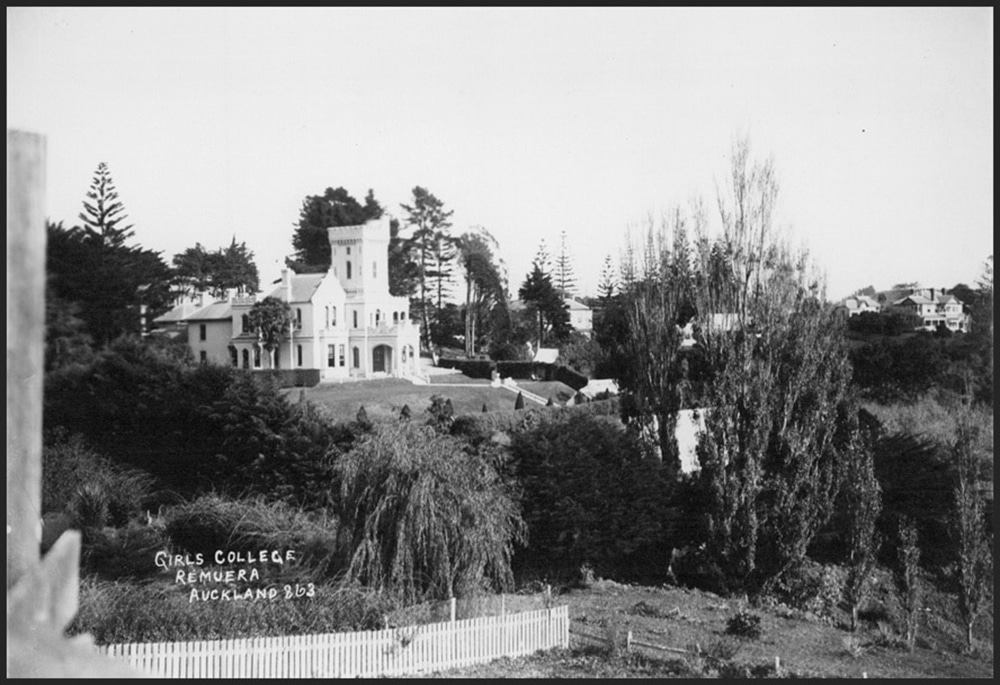
The Ladies’ College, Remuera, was one of the suburb’s longer surviving private schools.
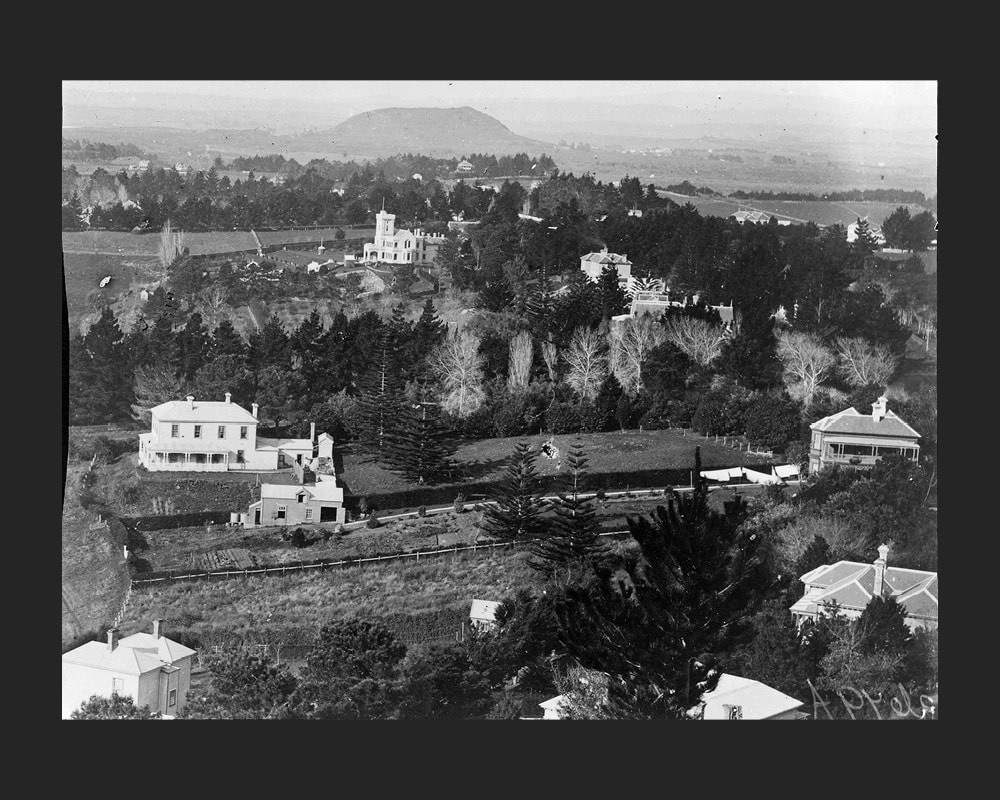
Image 1. View of Remuera in the 1890s, looking east from Mount Hobson. The area was still semi-rural. Portland Road runs from left to right, with the two-storey premises of the Remuera Ladies College started by Mrs Catherine Law on the left. In the background is Cleveland House with its tower, where the college later moved. Photographer J D Richardson. Auckland Libraries Heritage Collections, 4-2679-A .
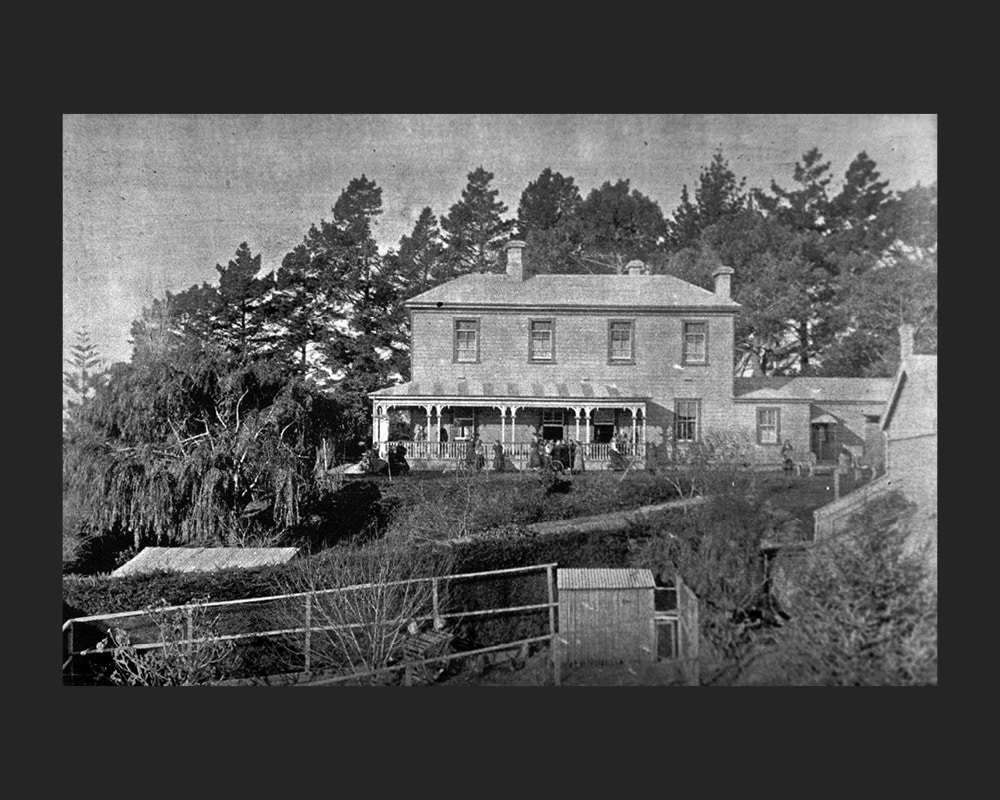

Image 2. The house in Portland Road, Remuera, built by Mrs Catherine Law in 1883 for her ‘Boarding and Day School for Ladies’. Some of the pupils can be seen on the front lawn. Auckland Libraries Heritage Collections, 7-A4483.
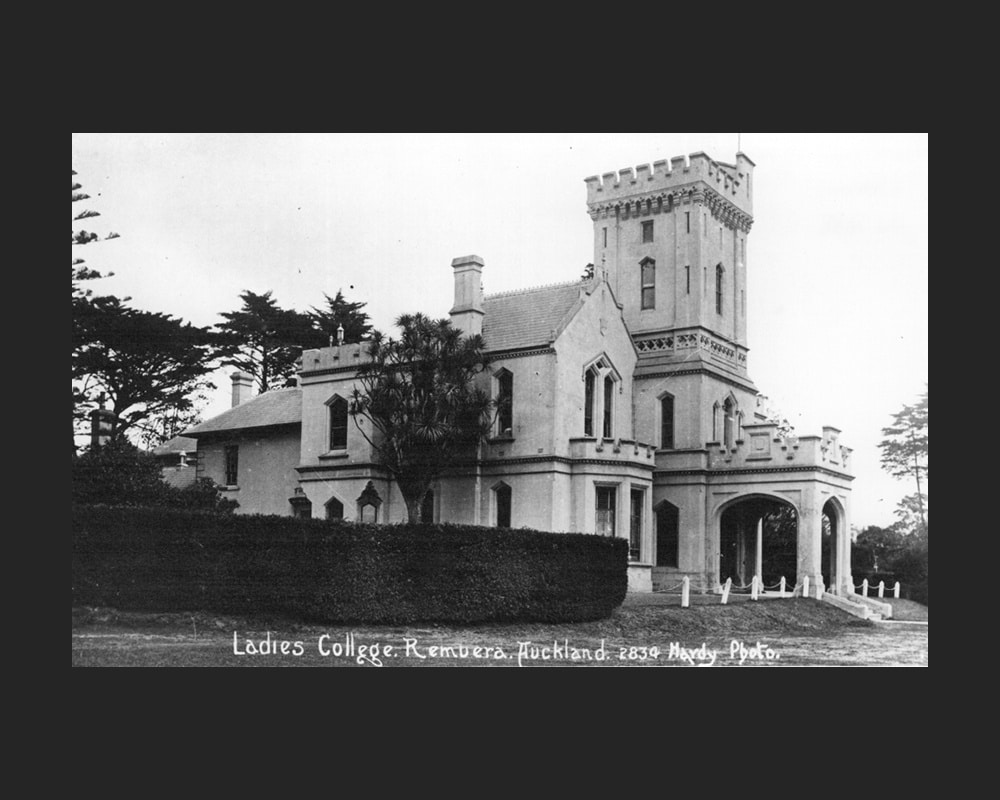
Image 3. An exterior view of Remuera Ladies’ College, showing the porte cochère, tower and battlements. Photographer Alfred Hardy. Auckland War Memorial Museum, PH-NEG-C28494.
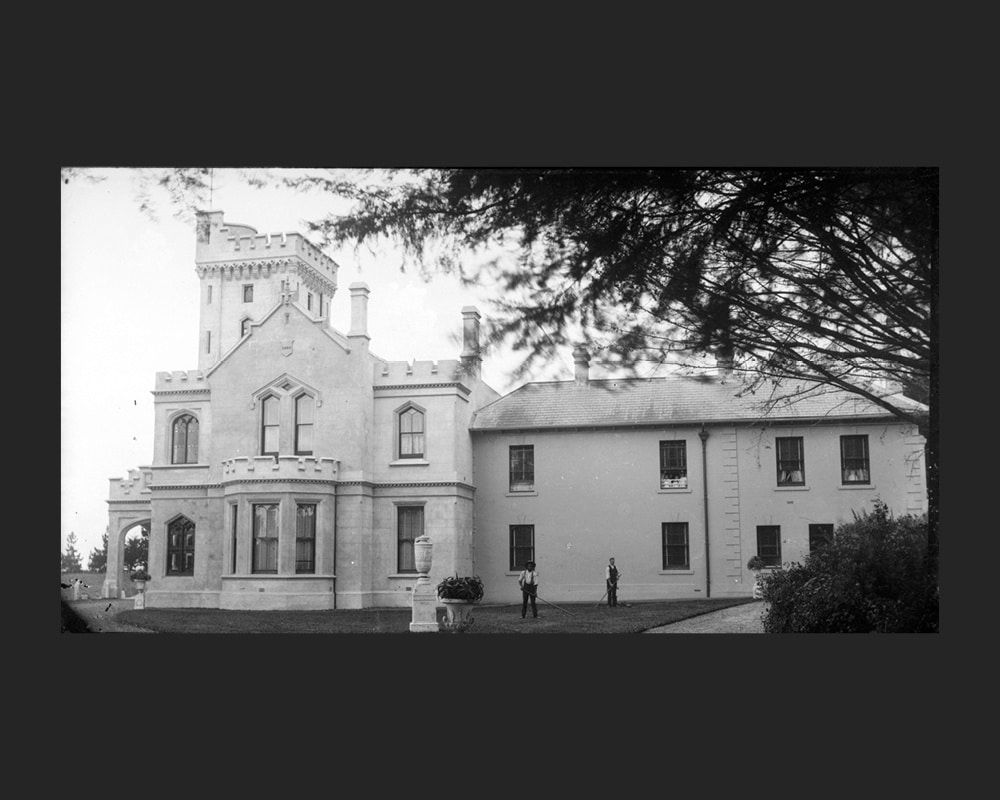
Image 4. Melrose Hall, the residence of Mr Alfred Isaacs, showing the original house (right) and the additions made in 1885-1886. Photographer James D Richardson. Auckland Libraries Heritage Collections, 4 -RIC69.
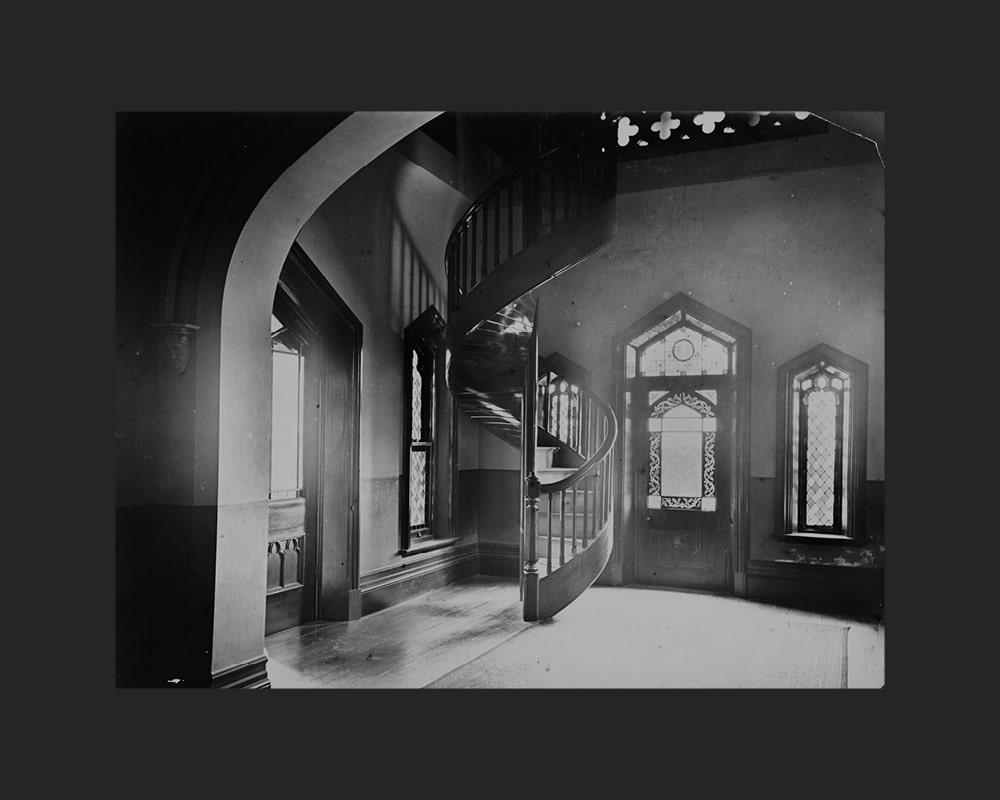
Image 5. An interior view of Remuera Ladies’ College taken in the 1960s, showing the spiral staircase leading up into the tower and the stained glass windows. Photographer John Tudehope. Auckland War Memorial Museum, PH-1965-3-6.
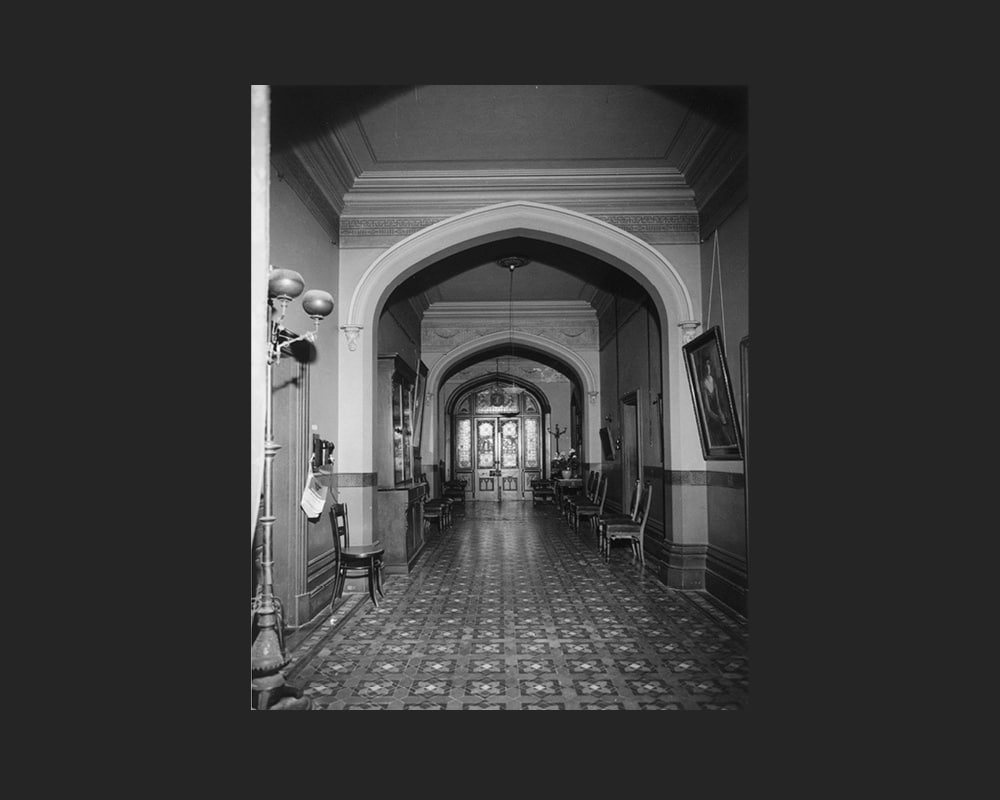
Image 6. View of the entrance hall of Remuera Ladies' College, taken in the 1960s. The magnificent tesselated floor and huge double front doors with stained glass were still in good condition. Photographer John Tudehope. Auckland Libraries, Kura Heritage Collections Online, 1706-002.
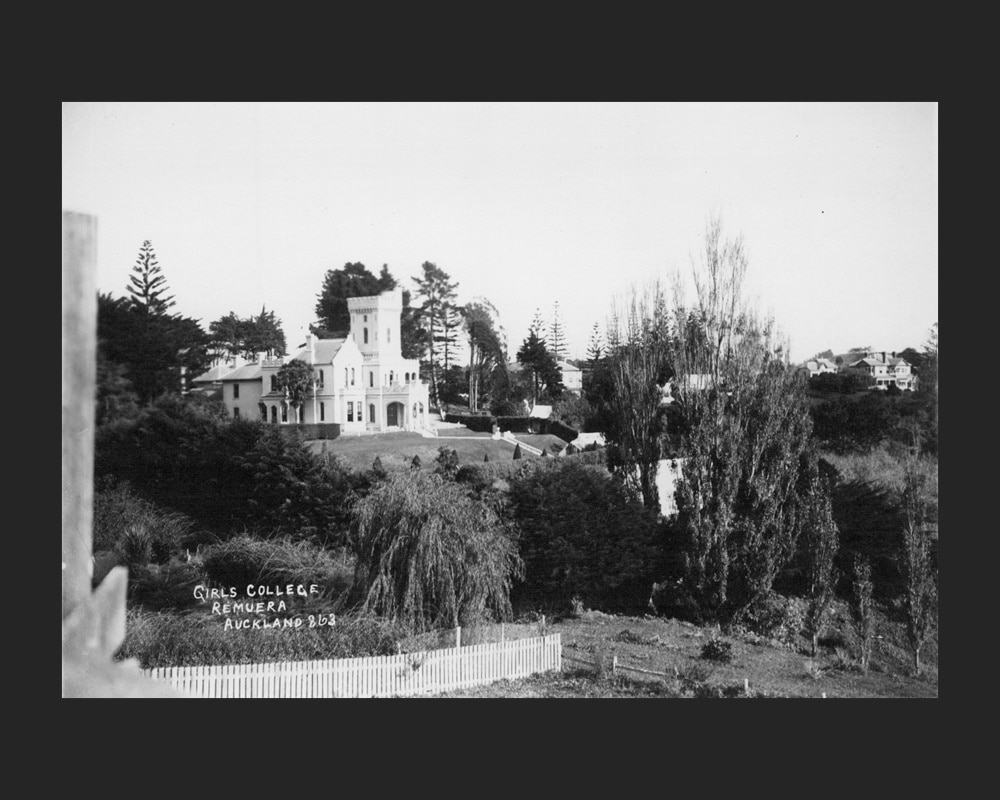
Image 7. A view of the Ladies’ College and grounds. Remuera still retained its semi-rural character in the early 1900s. Auckland War Memorial Museum, PH-RES-4331.
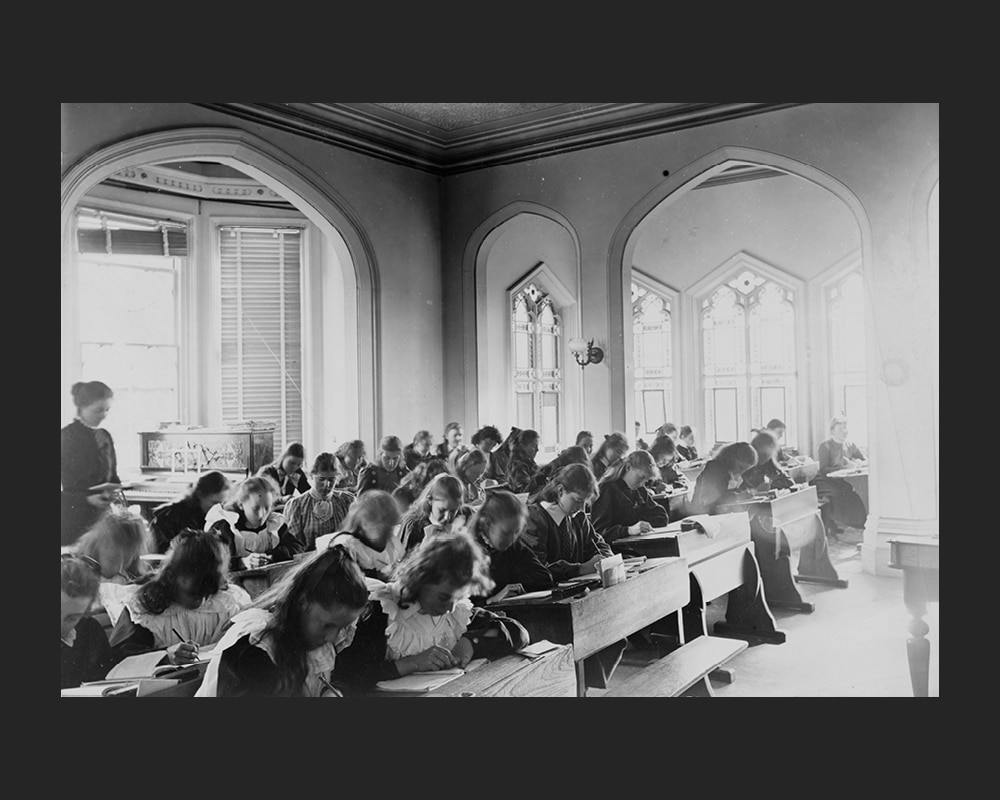
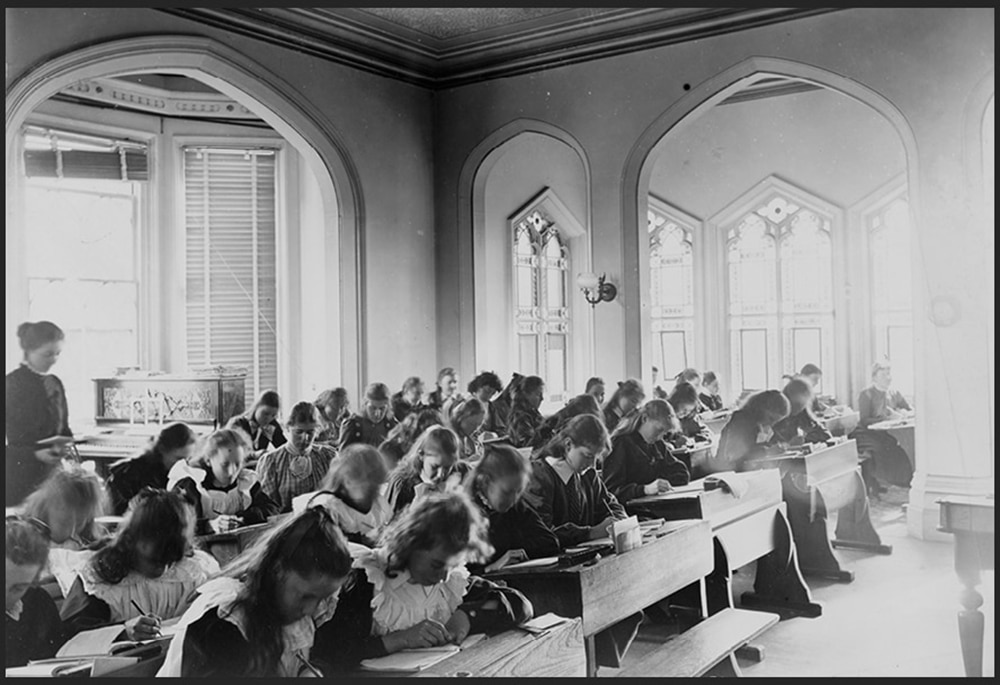
Image 8. Girls at their desks in one of the main classrooms at Remuera Ladies’ College. Auckland War Memorial Museum, PH-1965-3-9.
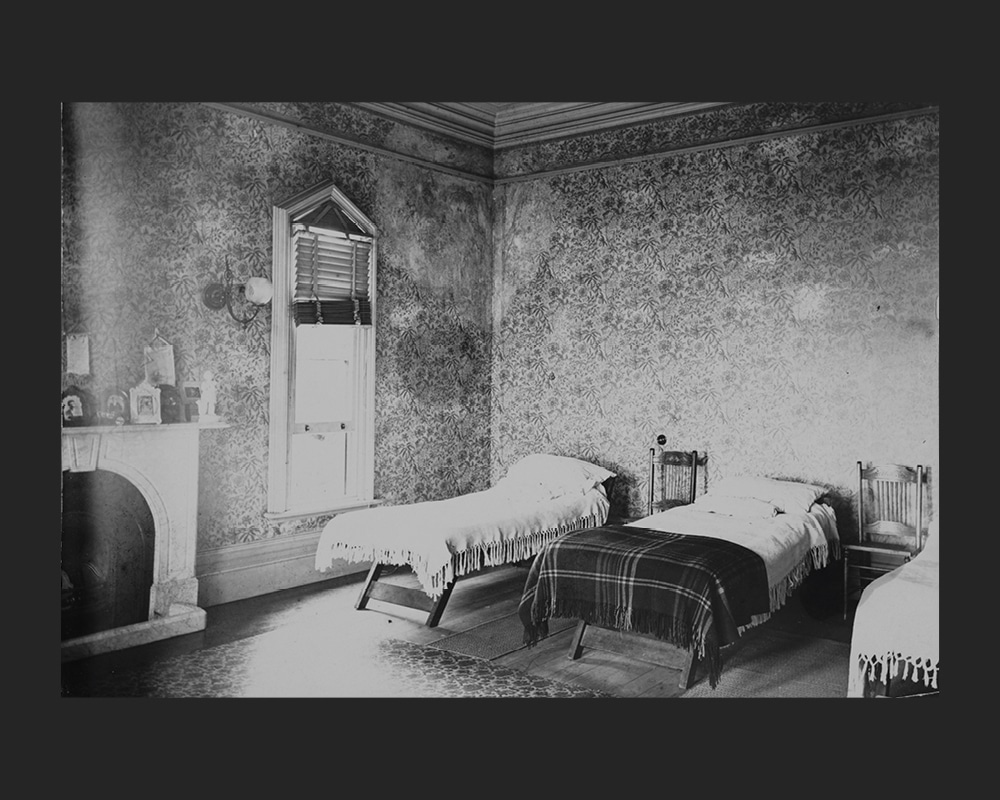
Image 9. A dormitory in the Remuera Ladies’ College. Auckland War Memorial Museum, PH-1965-3-5.
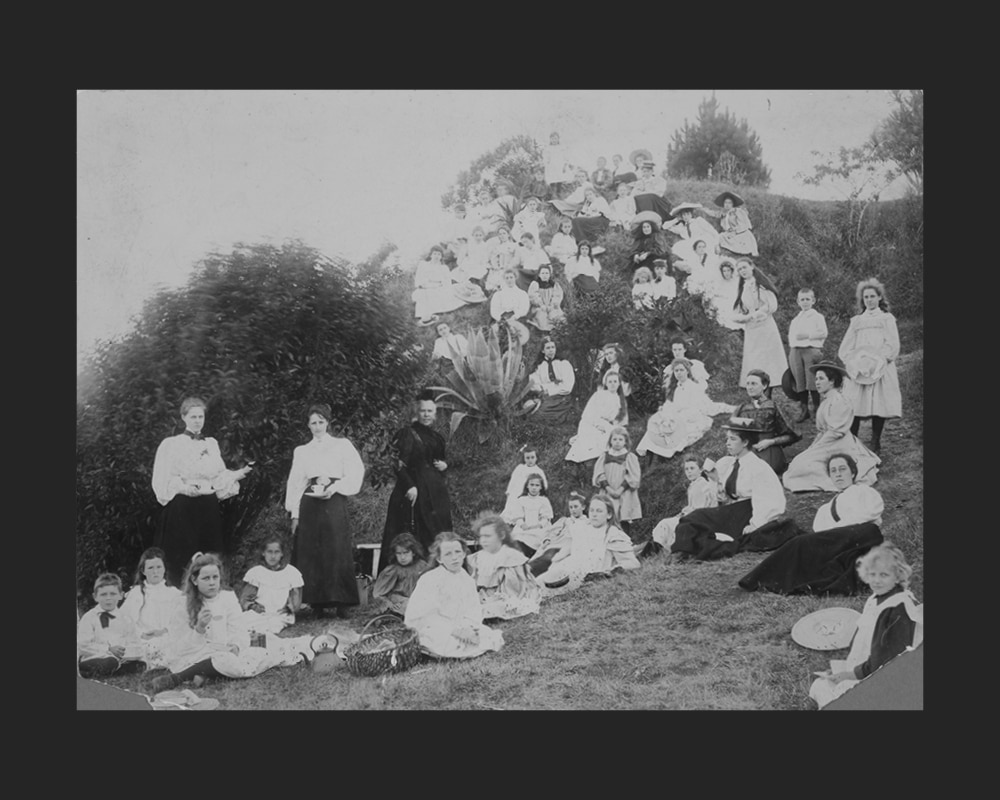
Image 10. Pupils of the Ladies’ College enjoy an outing to Auckland Domain. Auckland War Memorial Museum, PH-1965-3-24.
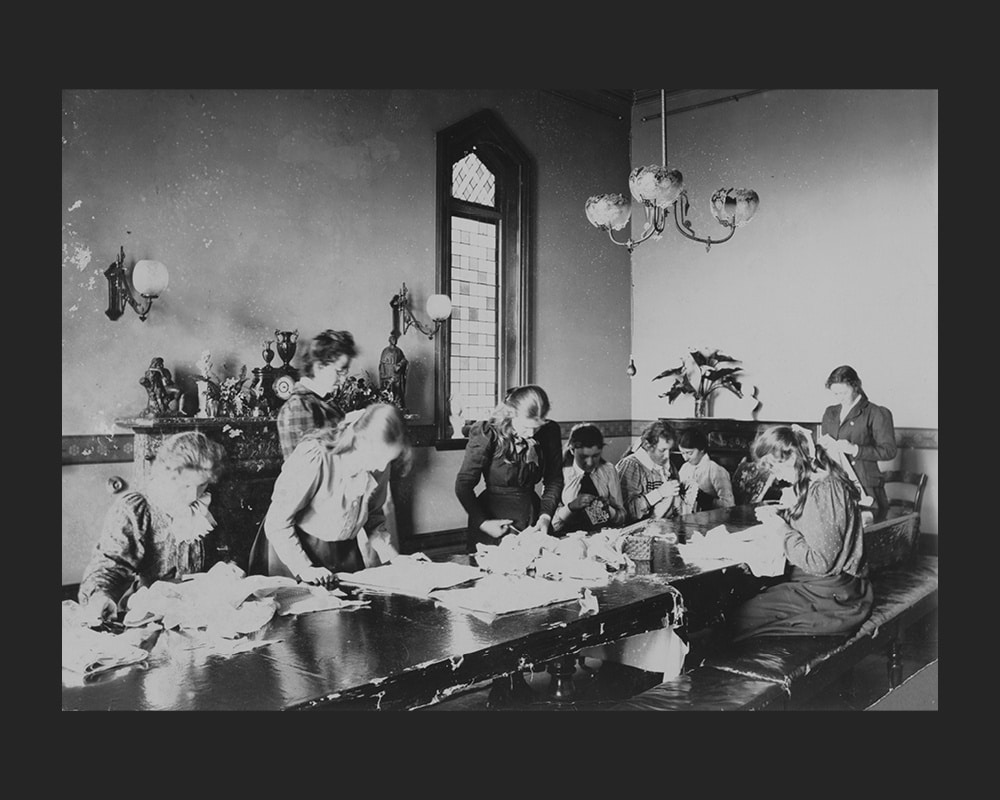
Image 11. Pupils of the Ladies’ College concentrate on their sewing. The teacher on the right may be reading to them while they work. Auckland War Memorial Museum, PH-1965-3-7.
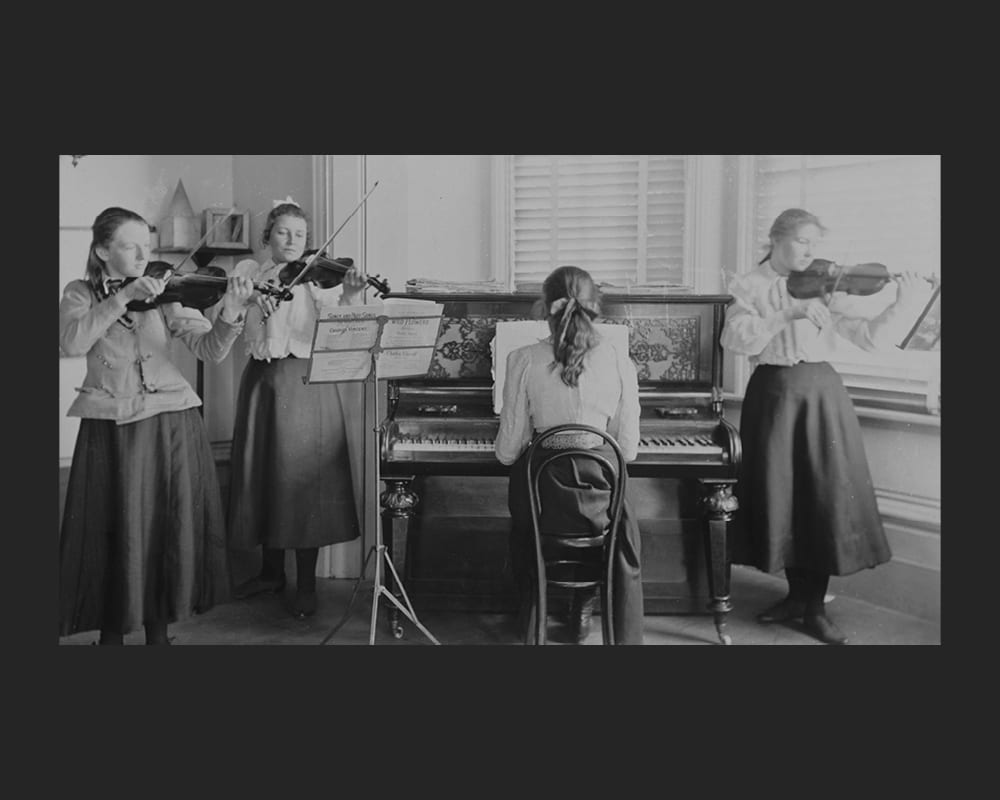
Image 12. A music class at Remuera Ladies’ college. Auckland War Memorial Museum, PH-1965-3-16.
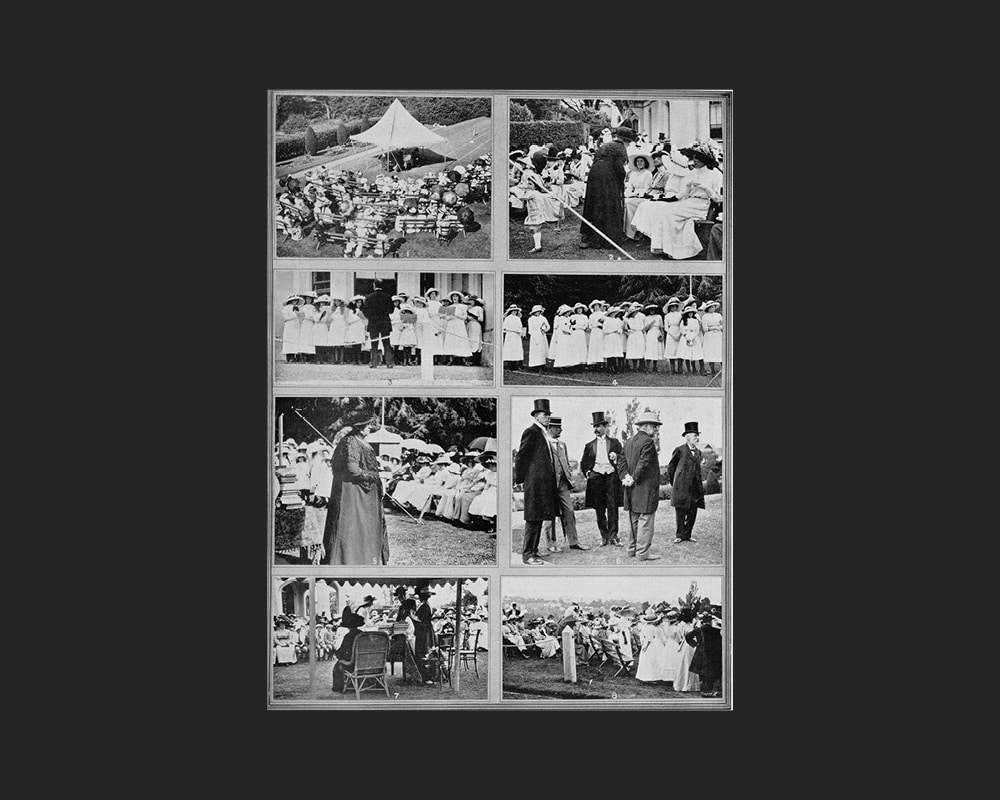
Image 13. Eight photographs from the end of term garden party at Remuera Ladies’ College. From New Zealand Graphic, 25 December 1912, p. 30. Auckland Libraries Heritage Collections, NZG-19121225-30-1.
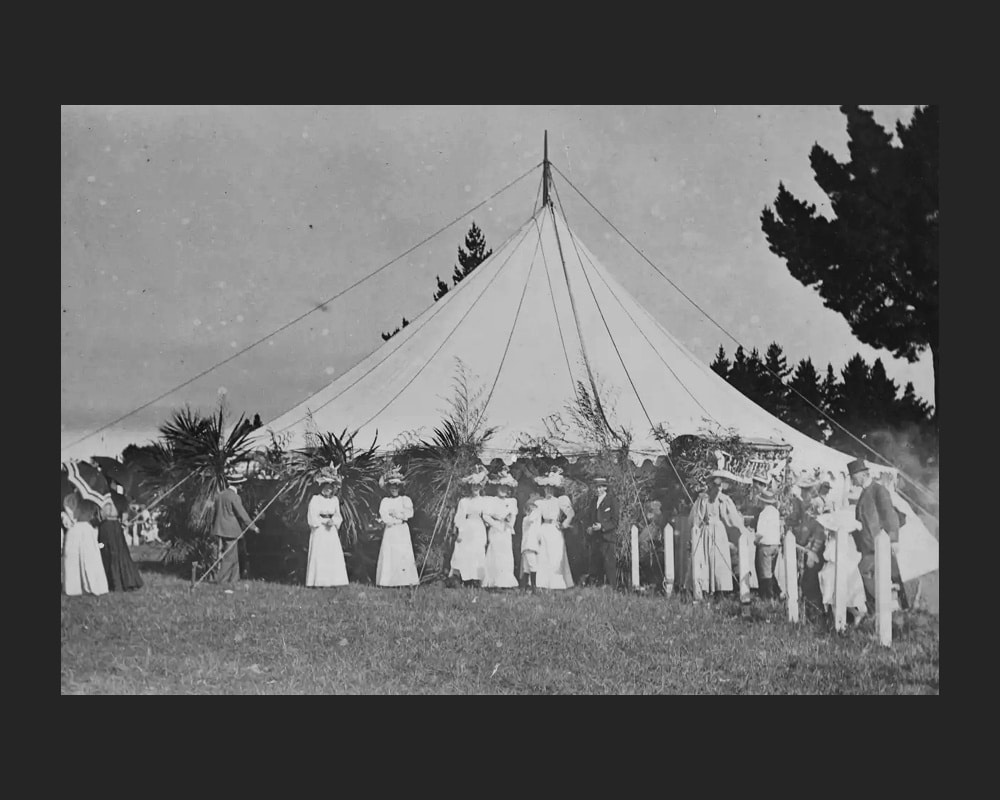
Image 14. Family and friends dressed in their finery gather at the marquee set up on the lawns of Remuera Ladies’ College for the annual end of year celebration and prize-giving. Auckland War Memorial Museum, PH-1965-3-22.
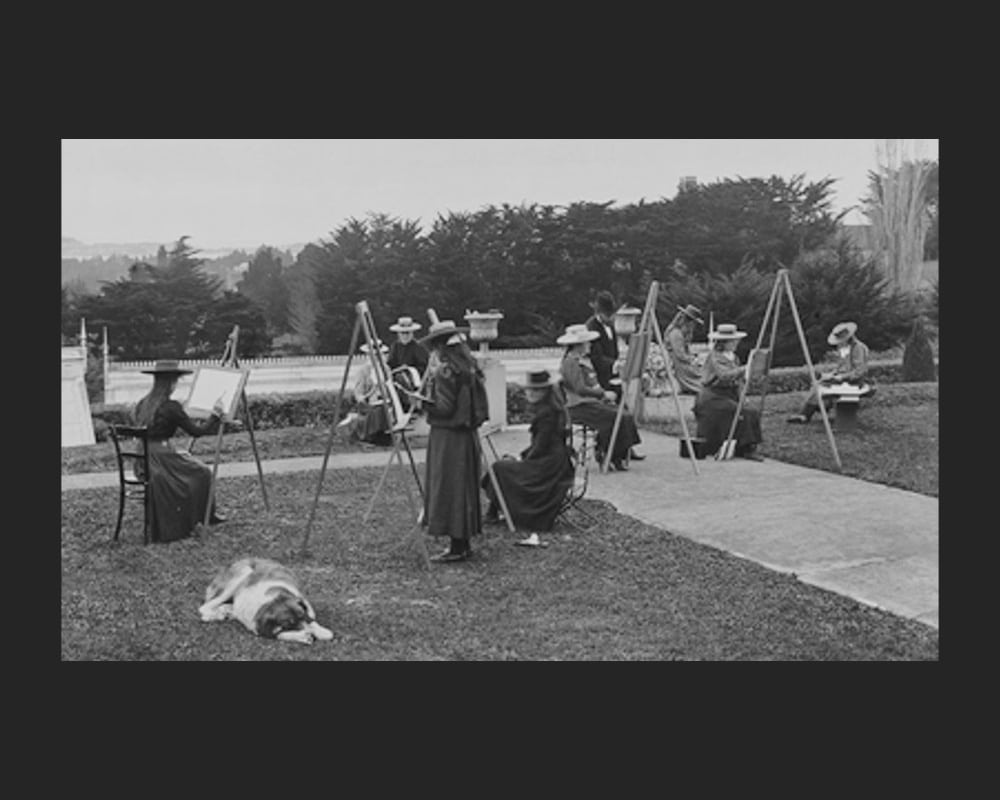
Image 15. The girls work at their easels, in an outdoor art class in the grounds of the college. Auckland War Memorial Museum, PH-1965-3-18.
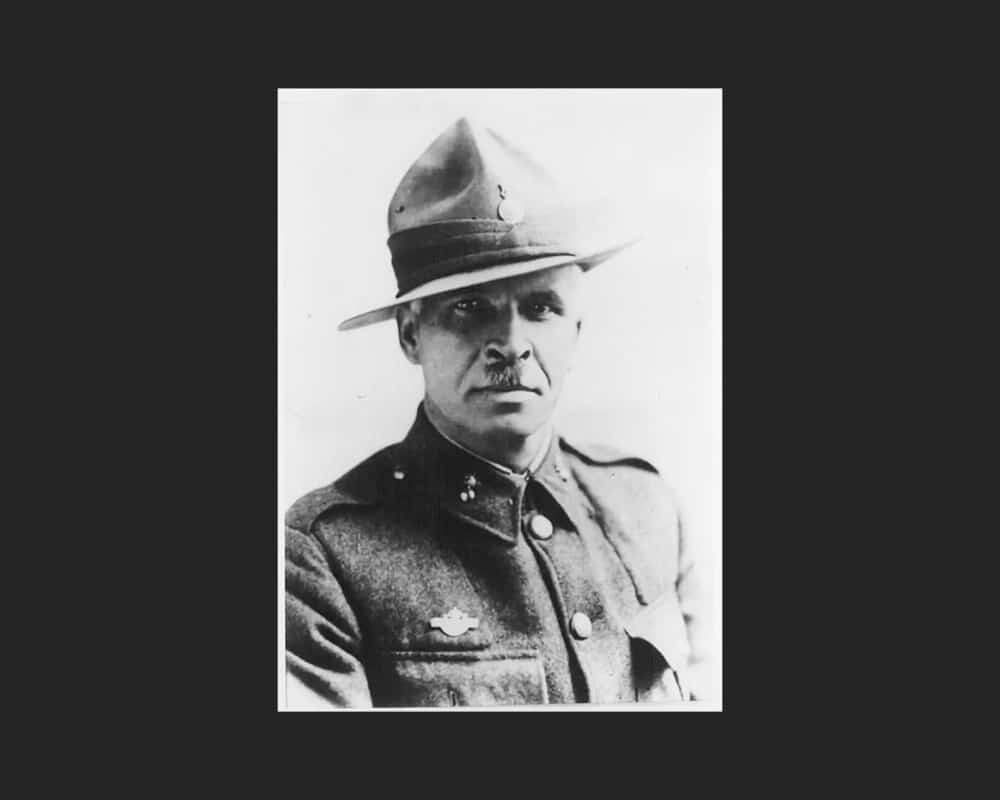
Image 16. Sapper Horace Moore-Jones, in his military uniform. Auckland War Memorial Museum, PH RESOS-200, PH-CNEG-C22390.
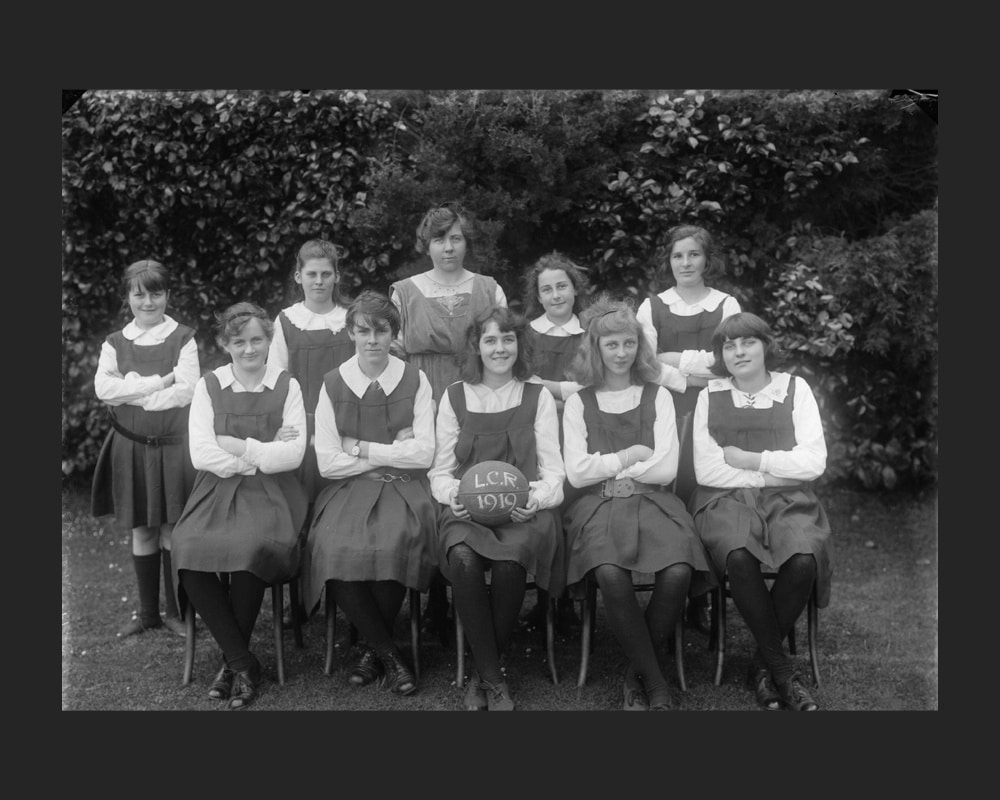
Image 17. Sport and physical exercise remained an important part of the curriculum at Remuera Ladies’ College. In its later years it fielded teams to compete against other schools in hockey, tennis and basketball. The Remuera Ladies’ College basketball team pose for a group portrait, 1919. Auckland Libraries Heritage Collections, 1054-649A.
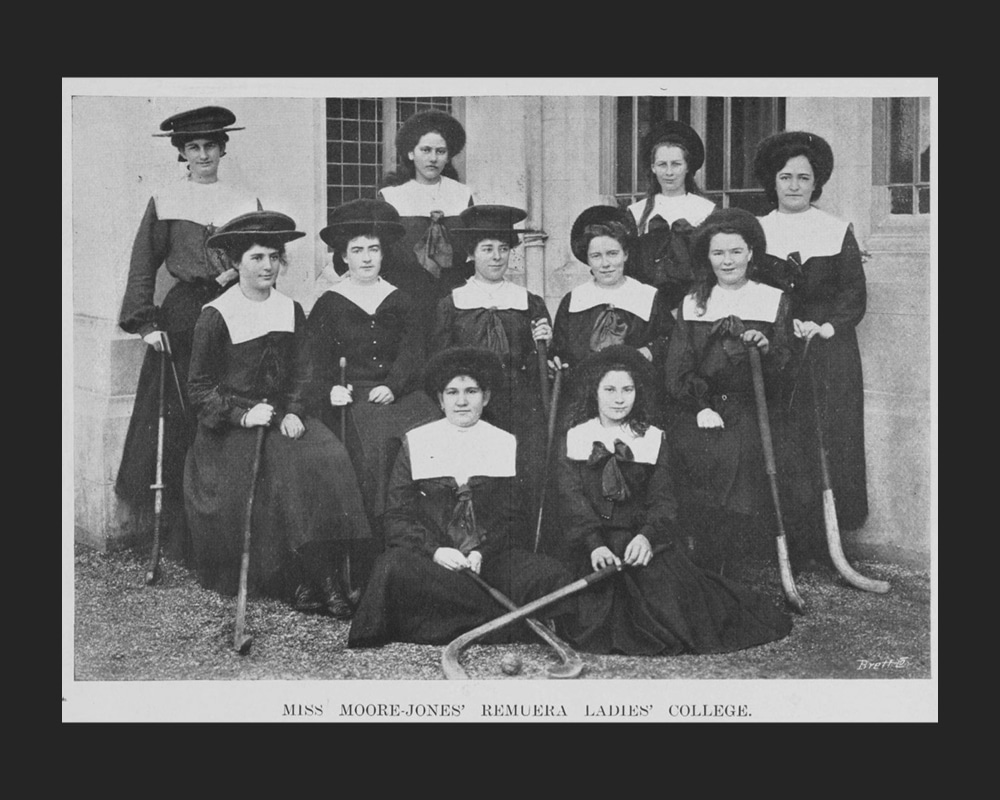
Image 18. The hockey team from Remuera Ladies’ College, 1905. Back row: Misses R Sellars, Nea Tucker, Mavis Clark, E Ensor. Middle row: Misses Macklow, Doris Tewsley, Ada Macklow, Sybil Payton, M Norden. Front row: Misses E Peckham, O Chandler. The New Zealand Graphic, 19 August 1905, p. 36. Auckland Libraries Heritage Collections NZG-19050819-36-2.
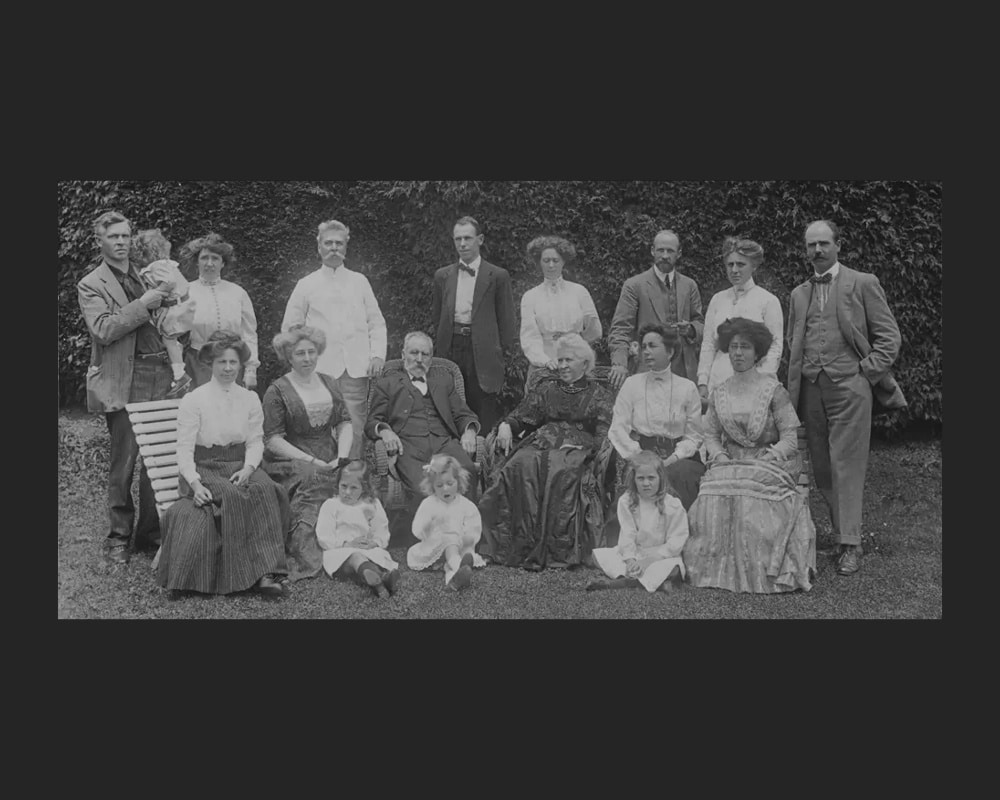
Image 19. Group portrait of the Moore-Jones family, including Sarah-Anne Moore-Jones and her husband David (centre). Auckland War Memorial Museum, PH-1965-3-4.
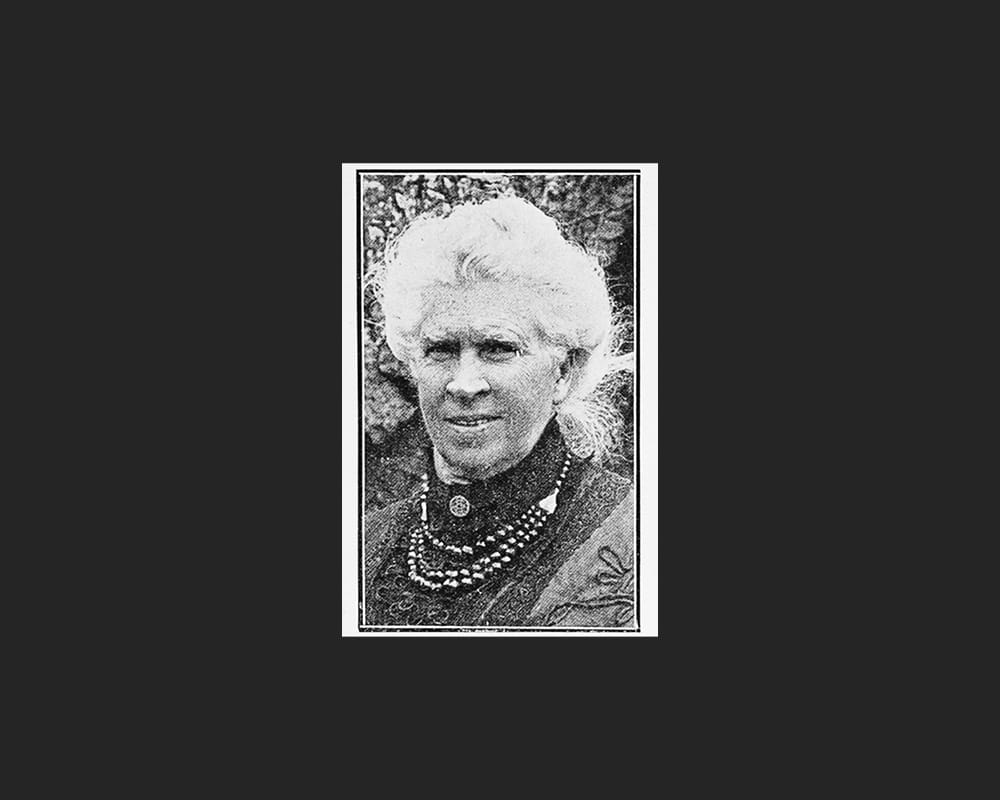
Image 20. Sarah Anne Moore-Jones in her later years. Auckland Weekly News, 18 September 1929, p. 38. Auckland Libraries Heritage Collections AWNS-19290918-38-2.
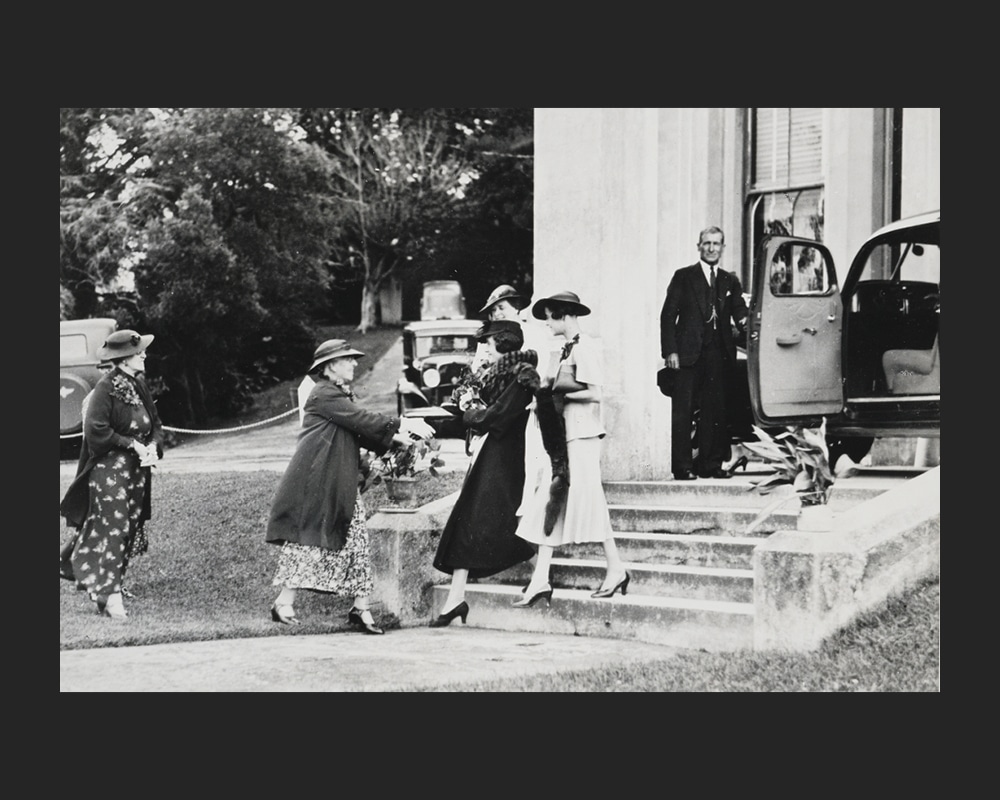
Image 21. Jean Batten arrives at Cleveland House, her alma mater, to attend a reception in her honour in January 1937. She was welcomed by a large crowd of well wishers, including former classmates. Auckland War Memorial Museum, PH-1965-3-34.
Founded in 1880 as the Remuera Seminary, it had modest beginnings, but survived for over fifty years, with several name changes.
From the earliest days of European settlement in Auckland the Remuera ridge and the sunny north facing slopes overlooking the Waitemata harbour were highly sought after, particularly for those who wanted to live in rural surroundings not far from the city. By the 1860s the area was beginning to attract successful merchants, entrepreneurs and professionals such as lawyers and doctors, who purchased land and built grand houses set in park-like grounds, with magnificent harbour views. They joined the pioneer land holders who continued to run working farms, so Remuera maintained its semi-rural character well into the twentieth century. To serve this community several small private schools for young ladies were operating in Remuera by the 1860s, including the Misses Fisher’s select school for young ladies, the Misses Anstey’s seminary and Mrs Butler’s school.1
Brief History
Provincial governments became responsible for education from the 1850s, but they generally subsidised existing private schools. Catering mainly for primary-age children, these schools raised funds by charging parents a quarterly or annual fee. The State did not establish free, secular education in New Zealand until 1877.2 The involvement of women in education, as members of school committees and as teachers, was part of a wider movement of women from the domestic sphere out into public life. Involving the raising of children, education can be seen as a natural stepping stone for this transition. Despite the introduction of free secular education for children aged 7 to 13 in 1877, it was by no means compulsory and only applied to Pakeha.3 During this period children assumed adult roles early, entering the world of work and contributing to the family economy, particularly in less well-off sectors of society. Sir Charles Bowen, an early New Zealand civil servant, made it clear that despite the introduction of the 1877 Bill, education beyond 13 years of age was only suitable for a limited number of children:
It is not intended to encourage children whose vocation is that of honest labour to waste in the higher schools time which might be better devoted to learning a trade, when they have not got the special talent by which higher education might be made immediately useful.4
In Auckland, small private or ‘dame’ schools were established during the second half of the nineteenth century, many by individual women in their own homes. Immigration to New Zealand offered women more freedom and opportunities for independence which were lacking in the more rigid class structure of Britain. Many worked as domestic servants but they also set up a variety of small businesses including dressmaking, laundry work and teaching in their homes, and running boarding houses, public houses and stores. They worked to supplement the family income and to support themselves and their children, especially if they were deserted or widowed.5
The women who established dame schools often had no formal teacher training, and equipment was limited to slates, a blackboard, a few text books and possibly a piano. These establishments only accommodated a small number of pupils, predominantly girls, and the subjects taught were limited – reading, writing, arithmetic, and in some cases music, deportment and elocution. Most of these schools were short lived; they either failed financially or closed when the teacher’s circumstances changed. However, they fulfilled an important role in a frontier colonial society where immigrants from Britain were focused on carving out new lives in an unfamiliar land, and art, music, and literature took second place.6
The Ladies’ College, Remuera, was one of the suburb’s longer surviving private schools. Founded in 1880 as the Remuera Seminary, it had modest beginnings, but survived for over fifty years, with several name changes. It closed in 1934. Over that time it operated in several locations in Remuera. The College set itself apart from other smaller, short-lived private schools in that it was established and managed over the years by two remarkable women, who were highly independent, experienced in the latest educational philosophies and methods developed in Britain, and committed to the education of girls. They were both dedicated to the welfare and progress of their students.
The Remuera Seminary
Remuera Ladies’ College began in a small house in Brighton Road, very much in the mould of the early Victorian private dame schools. Mrs Catherine Law, born Catherine Morton, was originally from Glasgow. She married William Law, a commercial traveller, in Blythswood, Glasgow on 26 March 1869 and had three children. Her two daughters were Alice Easton Law, born on 23 October 1870 and Mary Blythe Law, born on 13 August 1873.7 Unfortunately Catherine was widowed in her early twenties. Like many other women left to rear young children on their own, she turned to teaching and established a school in Rutherglen, Glasgow, known as the Sherrif Park Institution for Young Ladies, with her sister. They were running the school by at least 1875.8 While teaching in Glasgow, Mrs Law and her sister heard of a position in New Zealand, through another sister, who already lived there. Hearing about the opportunities in New Zealand, Mrs Law, with her young family, her mother and her sister, moved to New Zealand. They were part of a wave of immigrants who came to New Zealand from the United Kingdom in the 1870s, attracted by the government’s offers of free and assisted passages. In a bid to stimulate economic growth Sir Julius Vogel, who held various posts in government from 1869 to 1876, including Treasurer, Minister for Immigration and Premier, embarked on an ambitious scheme of major infrastructure projects including road and railway building, together with a massive immigration program to supply labour for these projects.9
On 18 September 1880 the sisters advertised the opening of their new school: ‘Mrs. Law and Miss Morton beg to announce that they intend opening a Select School, for the Board and Education of Young Ladies, at Brighton Road, Remuera [now Bassett Road] opposite Judge Arney’s.’10 Catherine Law was assisted in her work by her two sisters, who, according to historian Winifred Macdonald, were both well travelled and cultured women. In later years her daughter Alice also assisted her.11
Mrs Law chose the location for her exclusive girls’ private school well. By the early 1880s Remuera was well established as an enclave of the wealthy and privileged, who lived in comfort as English country gentlemen. Their wives, supported by retinues of servants, enjoyed a social round of garden parties, at homes, balls, weddings and concerts. These affluent families could afford to send their daughters to a small private school which groomed them to fulfill a similar role in society, as wife, mother, household manager and elegant hostess. The Remuera Seminary offered five years of tuition, three in the Junior Division and two in the Senior Division. The prizes awarded to pupils in December 1881, after the school’s first full year of operation, indicate that a variety of subjects were taught, in addition to the standard subjects of English, history and arithmetic: Ancient and modern history; geography; English literature, grammar and etymology; bible studies, arithmetic; French and German; music and drawing.12
The school was such a success, that soon the original house could no longer accommodate the growing number of enrolments. In January 1882 Mrs Law and Miss Morton announced they had moved to ‘a commodious house, with superior class-room accommodation’, situated next to St. Luke’s Church, on Remuera Road.13 The school catered for both day pupils and boarders. In 1883 Mrs Law built a large two-storey timber villa of 22 rooms on the upper corner of Portland Road and Westbury Crescent, more suitable for the accommodation and tuition of her pupils.14 The school relocated there and became known as ‘Portland Road (Remuera) Boarding and Day School for Ladies’ or more popularly ‘Mrs Law’s Girls’ College’. There was a concrete path in front where the girls played marbles, while the large garden behind featured a tennis court and lawns for drills and games. Although the school had less than half an acre of land, it was close to Mount Hobson, a scenic recreation reserve with views over the Auckland isthmus.
Over the next few years Mrs Law recruited a number of teachers to teach additional classes at the Seminary. In December 1884 she advertised for ‘a Gentleman to teach Latin and Mathematics in a Ladies’ School, hours from two to four; also a Drawing Master’.15 Professor Jules de Barnard, who ran a dancing academy in the city, taught the latest waltzes popular in Europe as well as traditional dances. His position at the Seminary was taken over by Monsieur Paul Bibron from Paris who taught deportment, dancing and calisthenics.16 Professor Barnard had appointed Monsieur Bibron to take over his dancing academy in April 1885, as he planned to leave New Zealand. From 1889, Professor Fisher, who had recently arrived from Europe and established a rival dancing school in Auckland in the Masonic Hall in Princes Street, taught dancing and deportment at the Ladies’ College, as well as a number of other private schools in Auckland.17 His classes proved extremely popular; within a few months he was running classes in halls in Ponsonby, Parnell, Mount Eden and Onehunga. Balls and dances were important social events among the well to do of Auckland and there was clearly a demand to keep up with the latest trends. By the late nineteenth century, as scientific advances were made in medicine and public health, exercise was seen as an important part of school curricula, with the aim of raising a healthy new generation. Professor Carrollo taught gymnastics and calisthenics.18
In November 1887 The Auckland Star reported:
Professor Carrollo’s pupils at Mrs Law’s private school, Remuera, gave a very successful drawing-room gymnastic display last night before a large number in the schoolroom. The young ladies went through various exercises in Indian Club and dumb bell practice to music, and also did some clever work on the Roman rings, etc., suitable for girls.’19
Art, music and needlework, seen as central to the education of young ladies in the Victorian era, were also an important part of the curriculum. Mrs Micklethwaite taught singing, and Mr George Clutsam taught piano. In December 1886 an exhibition and concert was held at the Seminary to mark the end of the school year. Over 50 parents and friends attended and the schoolroom was beautifully decorated with flowers for the occasion. The pupils’ work was displayed on walls and side tables, including freehand and map drawing, painting in sepia and colours, and ‘plain and fancy sewing’. The musical programme featured songs and solos and duets at the piano.20
By 1894 the school was known as the Girls’ College, Remuera, or Mrs Law’s Girls’ College, and was well established. There were around 60 pupils, ten of whom were boarders. Mrs Law was assisted by a matron, Mrs Kidd, who also taught cookery; a resident governess Miss Chrystal, who had previously been Assistant Mistress at the Ladies’ Collegiate School in Wellington; and ‘an efficient staff of teachers’.21
The Girls’ College survived the long depression of the 1880s and early 1890s, which was precipitated by the collapse of the City Bank of Glasgow in 1878. This led to a credit contraction in the City of London, then the centre of the global financial system, and a worldwide recession. In New Zealand, this was exacerbated by falling wool prices from the late 1870s. However, Auckland was insulated to some extent because it was not as dependent on the wool economy as the rest of the country, and had income from the gold mining boom in the Coromandel and strong timber exports to Australia.22 The city was reasonably prosperous during much of the 1880s, but when Australia went into depression towards the end of the decade, Auckland slumped too.
Although several leading Remuera businessmen went bankrupt and left the area, the community survived and the Ladies’ College survived along with it, continuing to prepare young women for the roles expected of them in middle and upper class society.
The Ladies’ College, Remuera
In February 1895 Mrs Sarah Anne Moore-Jones took over as Principal of the College, leasing the property from Mrs Law. Mrs Moore-Jones had a sound academic background in the latest educational theories and practices. She was born Sarah Anne Garner in London in 1839, and on 31 December 1864 married David Jones, an engineer, at Saint James church in Paddington, London.23 David Jones was born in Leigh, Worcestershire in 1835, the son of John Jones, a bootmaker. Rather than joining the family bootmaking firm, Henry Jones and Sons, by 1864 he set up his own blacksmithing shop. In the late 1860s David and Sarah Anne moved to Malvern Wells in Worcestershire, where David bought a large property with ground floor premises for his ironmongery and fancy goods business and several floors above suitable for accommodation. The couple let some of these floors as lodgings.24 Sarah Anne studied at Cheltenham Ladies’ College, founded in 1854 and one of the first schools in England to give girls a thorough training in all subjects, including sciences. The Principal there from 1858 was Dorothea Beale, famous educationalist and suffragette and a pioneer in training women as teachers. Sarah Anne went on to attend the Model Practising School established by Dorothea Beale, then became head and Mistress of Method at Cheltenham College. She also attended classes at the School of Art in South Kensington and taught in schools in Kensington. Her daughter relates that she was often selected to give model lessons before inspectors in London.25
Sarah Anne and David had ten children between 1866 and 1880: Garner, 1866; Amy, 1867; Horace, 1868; Herbert (Bertie) and Lionel, 1871; Archibald, 1875; Winifred (Winnie), 1876; Maria (May), 1877; Sidney, 1878; and Cowper, 1880. Sarah Anne somehow managed to juggle her teaching career with motherhood and child rearing. In late 1884 the Jones family set sail for New Zealand in the barque Glenlora. The Glenlora finally arrived in Auckland on 28 February 1885 after a slow voyage of 109 days from London. The vessel was delayed by lack of trade winds, languishing in the doldrums before crossing the equator.26
The decision to uproot the large family and travel to the other side of the world seems to have been prompted by David Jones’ bankruptcy. It appears he had little money of his own and relied on loans from relatives and others prepared to lend to him, to keep his businesses afloat. He got into serious financial difficulties in 1878 when the executors of an aunt demanded money that was outstanding from an earlier loan. In September 1884 he filed for bankruptcy, but the family emigrated to New Zealand before the matter was settled.27 David Millichamp Jones used the names of both his parents, John Jones and Harriet Millichamp, and once in New Zealand the family became known as ‘Moore-Jones’, perhaps to distinguish them from the many other ‘Joneses’.28 Another possibility may be David Jones’ desire to make a fresh start in a new country and put his bankruptcy in England behind him. He was said to be an invalid, which would have limited his capacity to work and meant his wife had to be the main breadwinner.
Mrs Moore-Jones taught in various schools in Auckland before taking over Remuera Ladies’ College in 1894. She applied unsuccessfully for a position as headmistress of Wanganui Girls’ High School in 1890, and the testimonial of Mr J H Upton of the Auckland Education Board is among those quoted in the Ladies’ College prospectus. Her three daughters trained as teachers, Winnie and May teaching general subjects and Amy specialising in music.29
An advertisement for the school in February 1895 outlined the curriculum offered.
‘Pupils will be prepared for Scholarships, Civil Service, Matriculation, and Teachers Exams, as desired… The classification will comprise Initiatory, Preparatory, Middle and Upper Forms. Kindergarten principles will be applied to the Initiatory. The School course will comprise the elements of a thorough English education, with French, Latin, Drawing, Bookkeeping, Hygiene, Domestic Science and Calisthenics, and Class Singing and Needlework, shorthand and Typewriting Classes will be formed. Advanced Mathematics, Classics, French, German, Painting, Music— piano and Violin taught by the best masters. To promote healthy competition one scholarship and Bronze, Silver, and Gold Medals will be offered for progress and general record.’30
The 1896 prospectus listed the following subjects in the curriculum: English and all subsidiaries; mathematics; book keeping; Latin; French; Calisthenics, drawing (freehand, model, geometrical, perspective); singing; needlework (plain sewing and mending first, then fancy work). According to the prospectus, history ‘is studied intelligently for its highest value and not merely as a storehouse of facts’. Latin was studied as a mental discipline, as a key to European languages and ‘because it unlocks the door to the professions which demand University degrees’. There was some science, although it tended to be more theoretical than practical; subjects included physiology, botany, hygiene, the chemistry of cookery and elementary astronomy.31
Cleveland House
In February 1900, after six years in Portland Road, Mrs Moore-Jones decided to move the school to Cleveland House, a beautiful property on the corner of Remuera Road and Victoria Avenue which she leased from Edward Withy, a well-known shipping magnate who had retired from Britain to New Zealand in 1884. The Portland Road house was later purchased by the Samaritan Society, a voluntary women’s organisation of the Union Free Church in Auckland. From 1903 to 1914 it housed the Remuera Children’s home, a residence for homeless children.32 In 1977 the Holt family bought the house, and a few years later relocated it to Henderson and restored it.33
In a for sale advertisement Cleveland House was described in glowing terms:
‘CLEVELAND HOUSE. REMUERA ROAD AND VICTORIA AVENUE’ – This well known, luxuriously-fitted Residence, brick-built and cemented. Containing 25 rooms, with lofty tower commanding marine and land scenery of the most beautiful in Auckland, together with about TEN ACRES of Land in paddocks. orchards. Vinery, hothouse, potting sheds, coach-house and stabling, stockyards, and sheds, concrete-built dairy and offices, gardener’s cottage.34
The first grantee of the land was Christopher Greenway, who in 1856 built the original house and ran a small 9 acre farm. The residence, which was known as Melrose Hall, later housed the Banks family from 1872 to 1878, when it was bought by a wealthy merchant, Alfred Isaacs. In 1885 Isaacs commissioned the architect David Ross to design a major addition to the front of the house. This transformed it into a grand mansion on the model of a mediaeval castle, with battlements and a parapet on top, a castellated tower approached by a spiral staircase, and an imposing porte cochère entrance. After moving there from Australia in 1862, Ross was based in Dunedin where he won commissions for a variety of major public buildings and private residences. He maintained an office in Auckland in the mid-1880s after winning a competition to design the Auckland Harbour Board Offices in Quay Street in 1883. He moved around frequently in the course of his career, returning to Australia in 1886.35
Edward Withy purchased the property from Isaacs in 1889. After the sale of the house and land, all the magnificent furniture, statuary, and ornaments of Melrose Hall were auctioned in what was billed as ‘one of the largest sales of furniture and effects that has been held in this province’.36 Isaacs was one of several Auckland merchants who declared bankruptcy during the depression in the late 1880s and he died shortly afterwards, in 1894.37 Edward Withy went to great expense renovating and repainting the house after he purchased it, spending over £700 on the painting alone. Historian Winifred MacDonald describes the opulent interior in its heyday:
“The rooms inside were lofty and spacious, the drawing room had gold glass in the windows, the ceiling was painted with stars and had heavily embossed wall paper. The entrance hall was positively baronial with tesselated floor, and huge double front doors.”38
Mrs Moore-Jones eventually purchased the property from Edward Withy in 1905, by which time the grounds had been reduced to seven acres. A curving drive lead from Remuera Road, named Garden Road in 1924, and another drive gave access to Victoria Avenue. The corner section was purchased by the Crown (New Zealand Post and Telegraph Department) in 1909 for the construction of a new Remuera Post Office, completed in 1914.39 The school had beautiful lawns in front, two tennis courts, large vegetable gardens, hot houses, stables (later converted into a studio), a large wash house presided over by an old retainer called Bells, and a well. There was also a paddock for two cows and a field near the road for the ponies of the day girls, many of whom rode to school each day. The two Coates sisters came from Orakei in a donkey cart which they drove themselves. Polly, the horse who drew Mrs Moore-Jones’ carriage, also grazed in the field.40
In the early 1900s, probably the heyday of the school, enrolments at the college rose to 30 to 40 boarders and the same number of day girls. Many of the day girls came from some distance, at first by horse buses run by Pullan and Armitage, Scarborough or Cutlers, and later by electric trams. In the 1890s a female guardian (advertised as ‘une garde dame’) travelled with the girls on the bus. Others came on their own ponies.41
Mrs Moore-Jones was ably assisted by her daughters Winnie, May and Amy. The large classroom was divided by a partition, Madame (Mrs Moore-Jones) taking the seniors in one part, Miss Winnie teaching the juniors in the other. Miss May took the youngest girls in another room and Miss Amy gave piano lessons to the juniors. In her history of Remuera Ladies’ College, published in the Auckland Waikato Historical Journal in 1987, Winifred MacDonald drew on some of the reminiscences of ex-pupils while it was still possible. She records the memories of a Miss Smallfield, who attended the school as young girl. She especially remembered the arrival of the dancing teacher Mrs Hudson Williamson, who wore a dress with a long train and walked into the room with great elegance. She would say ‘Now girls, we will take the steps for the waltz’. 40
These recollections reveal Mrs Moore-Jones as a woman of her time, in her deep respect for good family connections, an aristocratic way of life, and gracious manners. Her pupils recalled her with love and respect, as a kind woman who loved teaching for its own sake and empathised with children from all backgrounds. She was tall, dignified and had a great presence. She wore long sweeping dresses with a small train, and a little lace cap with a bow of stiff lavender ribbon. Pupils curtseyed to her when she came into the classroom and again before she left. As MacDonald comments ‘No error of deportment or dress escaped her eye’.41
Former pupils also recalled the daily routine at the school. The boarders were well cared for and well fed. The older girls slept upstairs, three or four to a room, the younger ones seven or eight to a room. Many girls remember the excellent ginger puddings and treacle tarts produced by the cooks, and the special Sunday dinners, served after the girls had walked to church and back. They looked forward to the large roast joint with baked vegetables followed by sweets. At mid-day dinner, which included most of the day girls during the week, table manners were strictly enforced. After dinner on Sundays the girls had free time for letter writing and scripture reading. On Saturdays they were taken on picnics to the North Shore by the old paddle wheel ferries, or on excursions to St Heliers beach or the countryside, for example Manurewa, by train. During the week after lessons the girls went for local walks, to Ellerslie racecourse, down Victoria Avenue or to the top of Mt Hobson. In the evenings Mrs Moore-Jones would narrate the current events of the day to the girls, which she had gleaned from the newspapers and carefully selected. The girls were not allowed to read newspapers, to shield them from the more unsavoury items. Or while they were doing their sewing she read to them from the classics or the ‘suitable’ novels of the day. 42
Food was one of the highlights of school life and an opportunity to bend the rules, especially for the boarders. Jessie Conrady was a personal maid to the Moore-Jones family, and lived at the College from 1913 until 1965, when the family finally left ‘the castle’, as it was popularly known in Remuera. Known fondly to the students as ‘Connie’, there wasn’t much that Jessie didn’t know about the girls’ activities and she aided and abetted them in their ‘secret’ midnight feasts. Interviewed in 1966, Jessie recalled that the girls gave her long lists of their favourite foods, including sausages, buns, sweets, cream and fruit which she purchased for them. The girls’ feasts were elaborate affairs – they borrowed crockery and cutlery from the kitchen which they washed and dried afterwards and even made fruit salads in the bedroom basins. Other popular schoolgirl pranks were midnight perfume and talc raids on the boys of nearby St John’s Collegiate School; secret rendezvous with ‘beaus’; apple pie beds; and tying pieces of string to someone’s toes so you could silently wake them up with a tug. The girls were officially allowed to socialise with boys in more formal settings, strictly chaperoned of course. Adeline Metcalfe (nee Dunning) was a boarder at the Ladies’ College in the early 1920s. She particularly remembered the annual balls held in the large schoolroom. Boys from St John’s Collegiate School were invited and the girls eagerly looked forward to dancing with them. (King’s College opened in Remuera in 1896; in 1913 St John’s Collegiate School merged with it. The College moved to Middlemore in 1922). 44
Day girls wore a navy serge uniform and a school hat with a band in the school colours. Boarders wore a pleated skirt and short jacket for going out; gloves and navy felt hats in winter, or straw boaters in summer completed their outfits. They were all expected to behave with decorum in public and appear suitably dressed, their gloves carefully done up down to the last button. Every Sunday morning a crocodile of girls walked two by two down the long drive on their way to church at St Mark’s in Remuera, dressed in their neat serge uniforms, hats and gloves. In school they wore a gym dress with a frilled, starched pinafore over the top.
More recently, in 1988, Louise Rooney recorded the memories of her grandmother Mavis Merlene Hill, who was born in Parnell in 1909 and attended Remuera Ladies’ College as a day girl from around 1920, when she was twelve. Her older sister Thelma was already a boarder there. Mavis recalled:
“School was very strict, it had a big assembly hall where the whole school would meet in the mornings, and then you would go off to your various classrooms. Mrs Moore-Jones would walk in in a very long black dress, with a little velvet purse hanging off her belt on the side and she would sit in her chair with her daughters one on each side of her, Miss Winnie and Miss Amy. Miss Amy took care of the boarders and the welfare of the school inside, the food and things and Miss Winnie was one of the teachers.”45
Mavis’s sister Thelma was at Remuera Ladies’ College during the 1918 flu epidemic. Mavis recalls the strict measures taken.
“During the flu epidemic my sister, Thelma, was a boarder at Ladies’ College in Remuera. The Moore-Jones family had a relative who was in the Grammar School at the corner of Ayr Street and Parnell Road, and all the boarders from Ladies’ College, who were well, had to go there and stay as residents and for their classes. The sick girls stayed behind at the school in Garden Road to be nursed. My sister wasn’t allowed to make contact with her parents, maybe because my father was working with the epidemic, and she used to come along Parnell Road and stand on the other side of the street and look over to our garage where my father or myself (only eight years old) would be pumping petrol into cars. She was so homesick to see her family and she wasn’t allowed to cross the road.”46
Mrs Moore-Jones was a genuine, practical Christian who would allow no sectarian prejudices, bigotry or racism. In her advertisements for the Ladies’ College she promised to provide ‘first class modern education to girls of all ages, with careful moral training on CHRISTIAN but UNSECTARIAN principles’.47 The pupils included girls of all Christian denominations as well as Jewish and Samoan girls; all were accepted without question. Mavis Hill remembers a number of girls from the Pacific Islands, especially the Nelson children.48
In the Victorian era the education of young women was oriented towards producing refined young ladies, well versed in correct etiquette and social decorum, appropriate to their future roles as wives and mothers and household managers. They were also expected to be able to entertain, with skills in singing, playing the piano, drawing and painting. Despite the opening up of employment opportunities for women from the 1890s, for most these opportunities represented the interval between school and marriage rather than a career. Marriage and motherhood were still seen as their destiny and their duty, while for men, ‘a job and a wage sufficient to support a family had become central to their identity as husbands, fathers, and heads of households’.49
The entry for the Ladies College published in The Resources of New Zealand in 1898 envisaged the following futures for graduates of the College: ‘pupils are trained for governesses, or they can study housekeeping, or for the University and Royal College of Music’. The distinctive features of the college were described as: ‘high moral tone, purely moral discipline, selected companionship, English manners and speech, maternal care and supervision, and a thorough home’.50
The subjects in which the Ladies’ College excelled were music, art and languages. Mrs Moore-Jones endeavoured to find the best teachers available in these fields. In 1895 advertisements she described them as ‘eight of the best visiting professors’.51 The school was advertised as ‘The Ladies’ College and School of Music, Remuera’ in the late 1890s and early 1900s, and it was stated ‘every instrument could be learned under its own master’. Of course, a female chaperone was present if the teacher was male. Professor Carl Gustav Schmitt headed the music department, assisted by a number of staff at various times, including Herr Zimmerman, Miss Alice Law, Miss Rimmer, Miss Milly Heyward, Miss Adams and others who taught the piano and violin.52 Professor Schmitt had returned from Australia in 1881 to assume directorship of the Auckland Choral Society. From 1888 he lectured in music at the Auckland University College and was also a prolific composer.53 Samuel Jackson taught the oboe at the College. Brothers Samuel and John Jackson were both members of the Auckland Orchestral Society. They performed regularly in concerts in Auckland in the 1890s and early 1900s, Samuel usually playing the clarinet and John the oboe.54
Alice Law, daughter of the founder of the Ladies’ College, Catherine Law, studied piano and violin in Auckland, including under Professor Schmitt and Herr Zimmerman. She pursued further studies in England, becoming a Licentiate of the Royal Academy of Music. She taught in a studio in central Auckland as well as at Remuera Ladies’ College. In 1902 she took up a position as a part-time music teacher at the Jubilee Institute for the Blind in Parnell, where her sister Mary had been a teacher since 1899. Alice Law’s piano teaching methods were very practical, using Braille.
She encouraged her students and their parents to believe that visual impairment was no impediment to the enjoyment of playing music, and trained several talented musicians. Music played an important part in fund-raising for the Institute, particularly during the depression. Concerned that the Institute’s band was all-male, Alice formed a girls’ orchestra. Alice never married, and was still working at the Institute when she died on 28 August 1942. Her sister Mary was head teacher at the Institute from 1923 until 1939. She was an eminent teacher of the blind and pioneered the latest teaching methods for the blind in New Zealand.55
At the annual ‘break up’ celebrations at the Ladies’ College in December 1898, Amy Moore-Jones’ music pupils presented her with an illuminated address, to thank her for the interest that she had taken in their work, and the assistance that she had given them in preparing for the junior musical examinations at the university. Fifteen girls from Remuera Ladies’ College were successful in the examinations that year.56 There was an orchestra and a choir, and each year the school produced an operetta held in St Mark’s Church hall as a fund raiser for worthy causes such as Queen Victoria Maori Girls’ School and Dr Barnardo’s Homes for destitute children in London.57 Voice training was emphasised not just in singing, but also in speech and elocution. As Winifred MacDonald observes, ‘Manners, speech, carriage and deportment were said to be matters of continual education and not reserved for dancing lessons only’.58 Music recitals by pupils, both vocal and instrumental, were a regular feature of the annual break ups and award presentations. These were elaborate events, with all the style of a fashionable Remuera garden party. After the presentations of prizes, parents and friends, dressed in their finery, enjoyed afternoon tea in a large marquee set up on the lawn, while pupils unobtrusively performed solos and duets. Men wore top hats and dress coats, while women wore the latest fashion in day dresses, teamed with broad-brimmed hats, gloves and parasols. In the schoolroom, beautifully decorated with flowers, the walls and tables were covered with displays of the pupils’ handiwork, in drawing, painting, dressmaking, leatherwork and other crafts.59
Painting and sketching were taught by some of the best artists in the country. Charles Frederick Goldie, one of New Zealand’s celebrated artists best known for his portraits of Māori, taught art at Remuera Ladies’ College in the late 1890s and early 1900s. Born in 1870, Goldie returned to Auckland in 1898 after studying art in Europe for four and a half years. He had been inspired to study at the Académie Julian and École des beaux-arts in Paris by his art tutor Louis John Steele. On his return to Auckland, Goldie’s dream was to establish an art school along the lines of the Académie Julian, and with Steele, he opened the ‘French Academy of Art’ in the studio they shared in Shortland Street.60
The Moore-Jones’ son Horace Moore-Jones, soldier, artist and teacher, taught art at Remuera Ladies’ College for some years, from around 1908 to 1912. Horace trained in art under the notable Auckland portrait painter and sculptor Anne Dobson; the couple married in 1891 and moved to Sydney. From 1892 to 1905 Horace exhibited with the Art Society of New South Wales; he returned to Auckland in 1908. In around 1912 he travelled to London, where he enrolled at the Slade School of Fine Art and joined Pearson’s Magazine as a staff artist. World War 1 broke out while he was still in England, and Horace enlisted in the British Section of the New Zealand Expeditionary Force. He participated in the Gallipoli campaign, working as a field artist making topographical sketches of the landscape in pencil and watercolour, and plans of allied and Turkish positions. His sketches of the rugged terrain, made under hazardous conditions, were an invaluable aid for planning military operations. Horace Moore-Jones gained celebrity status after the war ended. After his repatriation to New Zealand in 1916 his watercolours were exhibited around the country. It was while he was in Dunedin travelling with an exhibition of his work that he painted the first watercolour painting of his most famous subject, ‘The man with the donkey’.
A letter from Horace’s daughter Puti (born in 1906 to his second wife Florence Mitchell) written to her father from the Ladies College survives in the collection of the Auckland Museum. It was 1917, when war was still raging in Europe and in her letter Puti describes how Aunty May was making socks for the soldiers, and her Uncle Sidney was teaching her how to signal. During this period her father was often away, travelling around New Zealand on lecture tours. There is one other letter in the Museum’s collection, written to Puti by her father in 1917 to wish her a happy 11th birthday. 61 In 1918 Horace was appointed to teach art at Hamilton High School, travelling there from Auckland each week. Horace died in a tragic fire in the hotel in which he was staying, in April 1922. Although he had managed to escape, he courageously returned to the building to rescue others who were trapped there. 62
Another art teacher at the College was a Mr Wright, probably Walter Wright. The two brothers Frank Wright (1860-1923) and Walter Wright (1866-1933) were both artists, and from around 1888 shared a studio in Shortland Street, around the corner from Charles Frederick Goldie’s studio. Young ladies from private schools in Remuera, Parnell and Mount Eden came to the studio, where each brother had his own group of students. Walter also visited schools to give instruction, including Remuera Ladies’ College.63
Ida Eise (1891-1978), was another dedicated teacher at the College. She studied art at Elam School of Art from 1906 to 1915 and then taught art at New Plymouth Technical College. After she returned to Auckland in 1920 she joined the staff at Elam and also taught classes at the Ladies’ College. Ida taught at Elam until she retired in 1960. Even after she retired, she continued to teach one day a week at the Auckland Society of Arts, from 1962 to 1976. She had such dedication to her teaching and her students, it was to the detriment of her own career as an artist.64
Advanced French and Italian were taught by Monsieur Briffault, a cultured Frenchman, and Mlle Bouillon taught French and needlework. M. Briffault arrived in Auckland with his wife in 1894 and by 1895 established French reading and grammar classes, which he held in Symonds Street in the city.65 A Mme Albigani read French stories very slowly to the girls while they sewed and tried to follow her words. Some of these subjects were extras at £1.10 a term.66 French recitations from works by famous French authors such as La Fontaine and Molière were a regular feature of the end of year celebrations and prize-giving ceremonies.67
The relatively high fees at the Ladies’ College and its small size meant that it remained an exclusive school catering predominantly for the daughters of the well off. The fees in 1896 were £10.10s per term for boarders under the age of 12, and £14.14s for boarders over 14. Weekly boarders were charged £9 9s per term. Additional charges were made for laundry (13s) and stationery (5s). There was an inclusive fee of 20 guineas a term for boarders but it is not clear exactly what that included, presumably music tuition at least. The charges for day pupils were £1.10, £2.10, and £3.10 per term for Preparatory, Middle and Senior grades. By 1914 the fee for senior boarders (aged 13 and over) had risen to £16.16 per term.68
Although the emphasis on academic achievement at the Ladies’ College was less than we see in schools today, the College prospectuses suggest that Mrs Moore-Jones’ belief in a broad education for girls did change with the times to some extent, perhaps influenced by the educational ideas of her daughters. Some girls sat matriculation examinations, and a small number took courses in shorthand and typing. The addition of shorthand, typewriting and book keeping to the curriculum was a signal of changing times and the opening up of career opportunities for women outside the home, including clerical, factory, and shop work. By the late 1890s and early 1900s women were beginning to take up clerical jobs, for example in the civil service and local councils, and acquiring typing and secretarial skills was seen as a desirable option for young women with some education.69 However Mrs Moore-Jones’ primary goal remained a broad liberal education for her pupils, an education for life. As she wrote in a letter to parents in 1896:
‘The truest value of our work is not to be shewn in examinations or print but in the life, where may the adornment of all that is beautiful and acceptable in womanly character signally mark each pupil of the Ladies’ College, Remuera.’70
The Ladies’ College maintained its enrolment numbers into the 1920s. In 1923 the roll was 116, including 30 boarders. At the school break up at the end of that year, the prizes were distributed by the Reverend William Beatty, who congratulated the principal, staff and pupils on the year’s work, and observed that the individual instruction which the girls received at the college and the comparatively small number of pupils and small classes permitted ‘a care and attention to the individual pupil impossible in larger institutions’. One of the prize-winners that year was famous aviator Jean Batten, who received a silver medal in the yearly examinations in history and botany.71
Mrs Moore-Jones retired from active management of the school in 1921, after a lifetime dedicated to the education of women. Her daughters Amy and Winifred took over the school. Sarah Anne Moore-Jones continued to take an interest in the affairs of the school; she died on 7 September 1929 at the age of 91. Her husband David also lived to a grand old age; he died in 1926 at the age of 90. In her will Mrs Moore-Jones requested that Amy and Winifred should carry on the school she established and bequeathed to them the rights to occupy the land and buildings and entitlement to the profits from it.
One of the most famous pupils of the college was aviator Jean Batten. Born in Rotorua in 1909, in around 1914 Jean Batten moved to Auckland with her family, where she attended Melmerly School in Parnell. After Jean’s father Fred left to serve overseas in the First World War, her mother Ellen found it hard to make ends meet and she moved with Jean and her two sons, Harold and John, from Grey Lynn to Remuera. They rented a series of cheap houses on the south side of Remuera Road, and Jean attended Remuera Primary School. In 1922, when Jean was 13, she went to board at Remuera Ladies’ College in Garden Road. Her father had returned from the war and resumed his dental practice, so he could afford to pay the school fees. By this time Fred and Ellen had separated and Jean remained with her mother while her two brothers Harold and John had been sent to Australia and England respectively. Jean did well in her exams and won prizes in scripture, English, music, history and botany. Just after her 15th birthday in 1924, when she was in the fourth form, Jean left Ladies’ College. There was a polio epidemic in Auckland and Jean refused to go back to college after an extended summer holiday. She went on to have private tuition in dance and music, and did courses in shorthand and typing at a secretarial school.72
Jean enjoyed her time at Ladies’ College and threw herself into all the activities the school offered. In her memoir published in 1938 she wrote:
‘When I grew older I was sent to board at a very beautiful college, which was designed on the lines of a small castle and situated amid wide lawns and lovely gardens. The headmistress was an Englishwoman, and with her daughters endeavoured to instil the English traditions into the pupils. The time I spent at the college was a happy one. My favourite subject was, I think, geography. I was very fond of art too, and had evinced a deep love of music. I passed several music examinations, and was very pleased on one occasion when an original design for a poster which I painted won a silver medal in an exhibition. All New Zealanders are fond of sport, and I was never happier than when indulging in one game or another or striving earnestly for my team in a basket-ball match or tennis tournament.’73
Mavis Hill was a contemporary of Jean Batten at Ladies’ College in the 1920s. Mavis recalls:
“Jean Batten was a personal school friend at Ladies’ College. I went to two parties at her home, in Clonbern Road, just about where the supermarket is now. She was a lovely person, she had dark, curly, short hair and she had a very nice mother. Her father didn’t live at home, he had been a dentist, and there had been a separation and she was very much under the control of her mother.”74
Jean and her mother developed a close and intense relationship. Ellen had encouraged Jean to become a high achiever from a early age, and when she was younger Jean’s dream was to become a professional concert pianist or ballet dancer. But her ambitions changed after she left school. Ellen had taken her to Mission Bay to watch the Walsh brothers’ flying boats, in which pilots were being trained for war service. Then after the First World War, there was the golden period of pioneering long distance flights by pilots such as Sir Charles Kingsford Smith and Charles Lindberg. Inspired by their feats, Jean determined to become a famous pilot competing on equal terms with men, and her mother supported and encouraged her in her ambitions.75
In 1929, having sold Jean’s piano to pay for the fares, Jean and her mother sailed to England so Jean could learn to fly. Overcoming many setbacks, in 1934 Jean succeeded in beating Amy Johnson’s record for a solo flight from England to Australia, set in 1930, and in 1935 she became the first woman to fly solo across the Atlantic from England to South America. Jean Batten maintained her links to Remuera Ladies’ College, despite her fame as an international celebrity and her residence in London. In October 1936, Jean embarked on the longest of her epic flights, the first ever direct flight from England to New Zealand. She made the journey in a Percival Gull aircraft in 11 days, a world record for solo flying by a man or woman. Arriving at Mangere aerodrome in Auckland on 16 October, Jean was greeted by an enthusiastic crowd of 6,000. Among them were some of her former school friends from Remuera Ladies’ College, and on her arrival they handed her a floral lei tied with the school colours of royal and turquoise blue. The Auckland Star reported:
‘Women members of the Aero Club and members of the Old Girls’ Association formed a guard of honour to the clubhouse, the passage roped off with streamers in red, white and blue and royal and turquoise blue. The clubhouse itself had been adorned with masses of spring flowers, including hothouse primulas and stocks, cyclamen, gladioli and irises.’76
In January 1937 Jean Batten attended a reception at Cleveland House, organised by the committee of the Cleveland House Old Girls’ Association to pay tribute to her achievements. The guest of honour was received on the lawn by Amy and Winifred Moore-Jones, the former principals of the school.77 The Secretary of the Old Girls’ Association, Anita Webster, who was a close friend of Jean when they both attended Cleveland House, later travelled to Europe and England. She was there to welcome Jean on behalf of the Association, when Jean touched down at Croydon airport after her long return flight from New Zealand.78
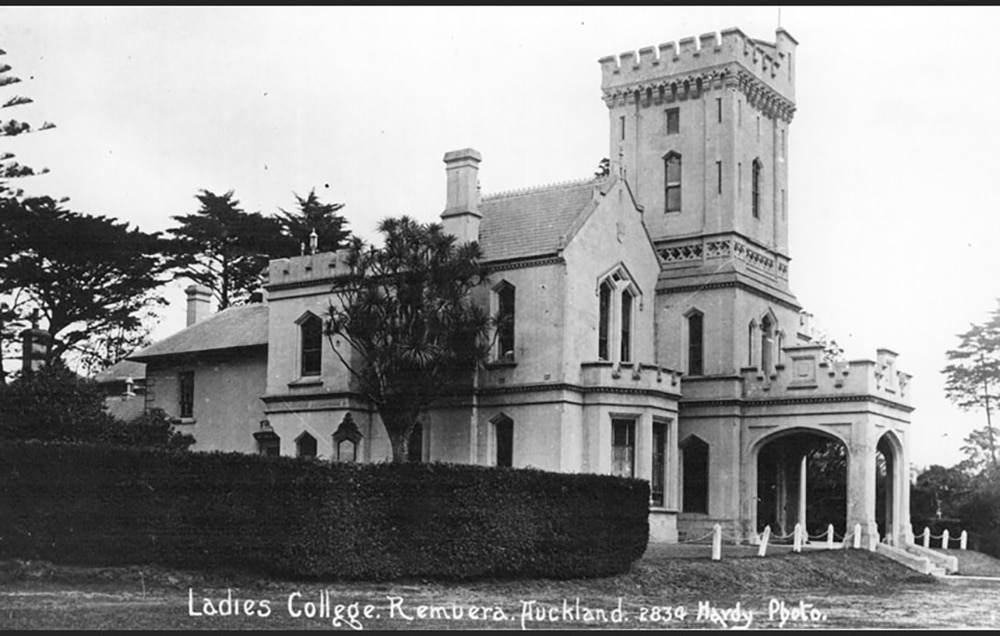
Image 3. An exterior view of Remuera Ladies’ College, showing the porte cochère, tower and battlements. Photographer Alfred Hardy. Auckland War Memorial Museum, PH-NEG-C28494.
The demolition of Cleveland House was a great loss to Remuera’s built heritage.
It was a remarkable building which had evolved from farmhouse to mansion. For over thirty years it housed generations of girls who were groomed to become young ladies endowed with ‘all the Victorian womanly virtues’.
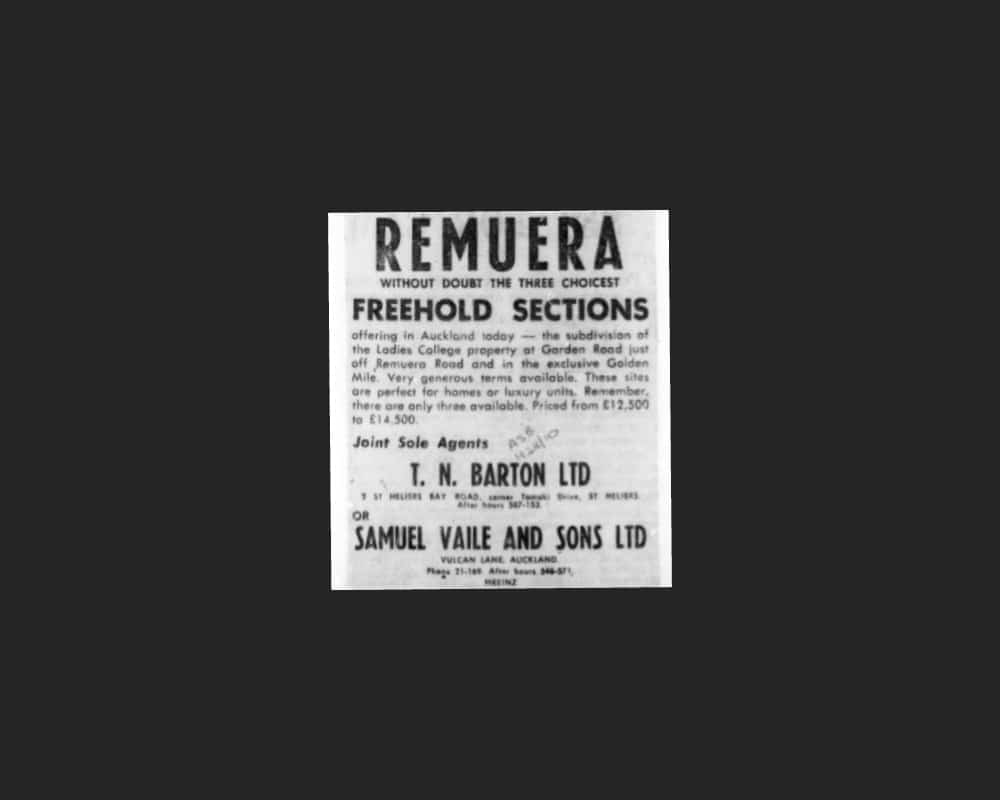
Image 22. The New Zealand Herald, 28 October 1966.
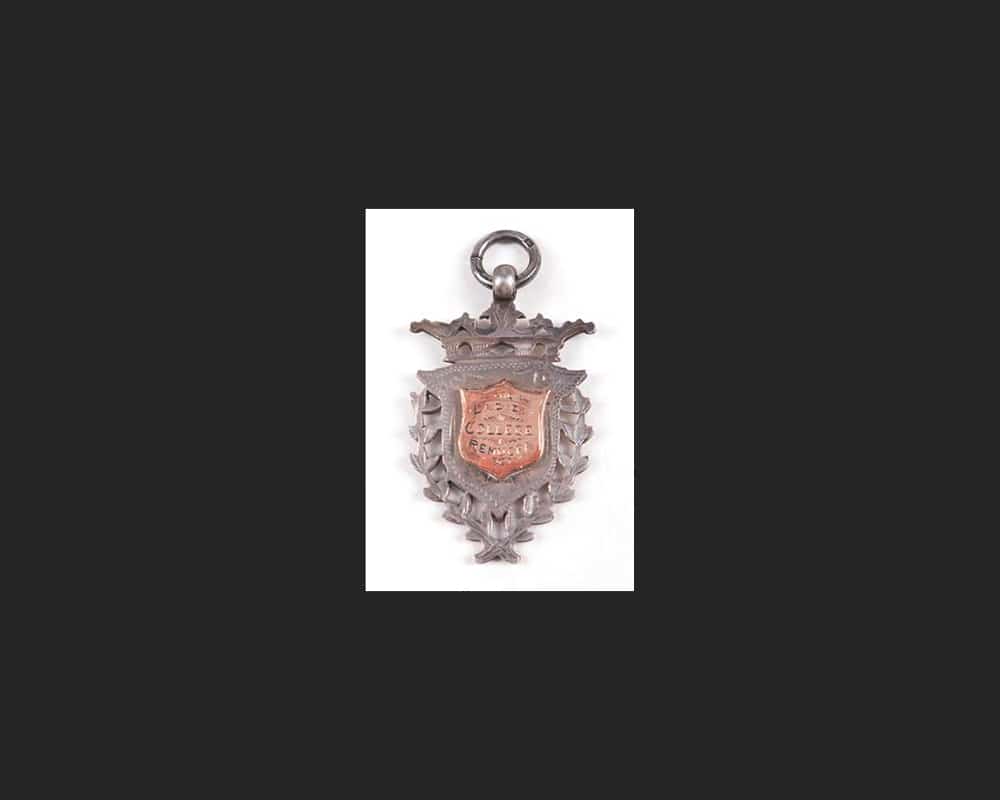
Image 23. Remuera Ladies’ College badge. Auckland War Memorial Museum, 2019.19.1.
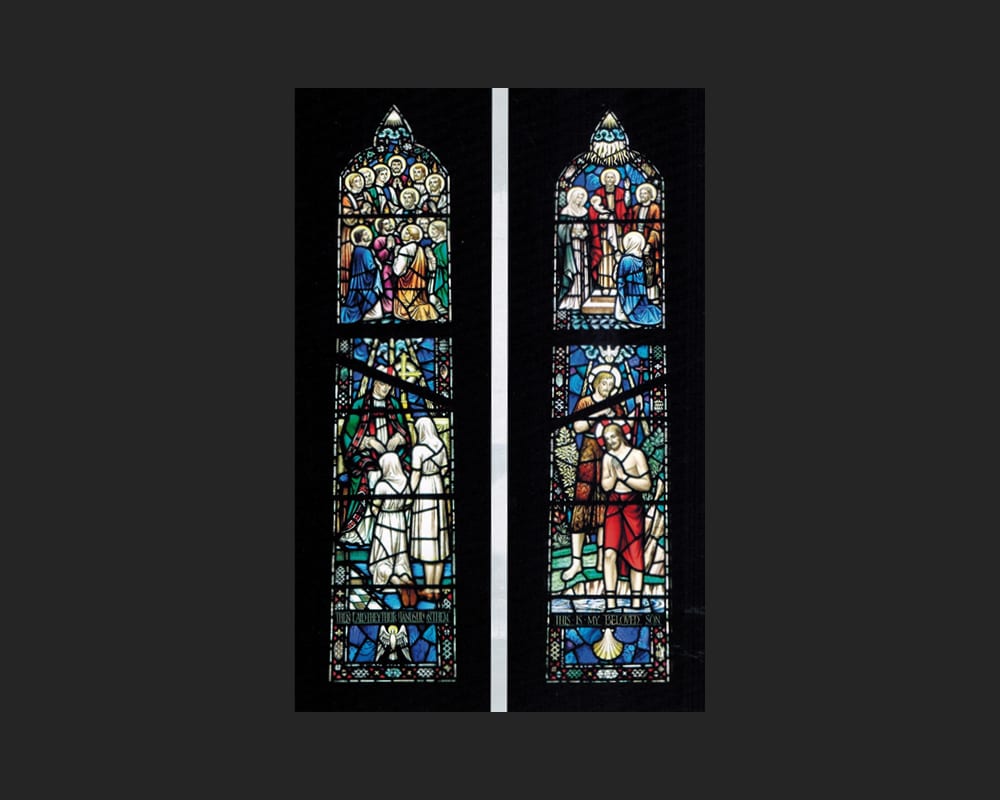
Hilary Reid, Windows of Saint Mark’s Remuera, Vestry of St Mark’s, 2004. Window 8a.
THE END OF AN ERA
By the 1920s this small, exclusive school was facing competition from newer, larger schools both public and private, which had specialist staff, extensive playing fields and facilities for subjects such as science. Times had changed, and there was no longer a place for this Victorian school, which had become an anachronism. From the mid-1920s the roll started to decline and parents sent their girls to nearby, better resourced schools such as Diocesan School for Girls (established in 1903), Epsom Girls’ Grammar (established in 1917) and St Cuthbert’s College (established in 1925).
The Great Depression of the 1930s also had an impact on Remuera and therefore the school. Although residents did not experience the same poverty and poor living standards which people living in crowded inner city neighbourhoods endured, the Depression irrevocably changed the physical and social landscape of Remuera. Servants were becoming increasingly rare; more and more women were going out to work; as the large estates were subdivided modest State houses sprang up beside grand homes, and a whole new suburb, Meadowbank, emerged to the east.79
During its final years the Ladies’ College was known as Cleveland House. It only catered for junior pupils, and also took a few boys as well as girls. The school finally closed in 1934. Joan Thompson, born Joan Gwendoline Wright in 1927, is the last surviving pupil of Remuera Ladies College. She attended the College from the age of six or seven, only for the last year or so the school was open. Her maternal grandparents paid the fees; their property in Garden Road adjoined the College so Joan could just go through the fence to get to school. She was one of the youngest pupils and vividly recalls the big girls taking her all the way up to the top of the spiral staircase and the beautiful view from the turret, looking out over farmland and the harbour: ‘you could see all over Auckland’. Her teacher was Marney O’Reilly. According to Joan one of the main reasons the College closed was that Winifred and Amy Moore-Jones were getting old. After Joan left, she went to Remuera School.80
Many former pupils kept the memory and reputation of the school alive after it closed its doors. An Old Girls’ Association was formed and meetings and annual dinners were held, attended by ‘large numbers of town and country members’. The dinners were often held at the Hotel Cargen in Eden Crescent, and after the meal the women played bridge and mah-jong and enjoyed a late supper in the lounge. Members of the Association also organised bridge parties and attended ‘at homes’ at Cleveland House, hosted by their former principals, Amy and Winifred Moore-Jones.81
In 1959 former pupils of the Ladies’ College raised funds for two stained glass windows in memory of Sarah Anne Moore-Jones and her daughters Amy and Winifred. They began negotiations with St Mark’s Church in Remuera, the church attended by generations of girls from the Ladies’ College. The windows, which replaced two existing plain glass windows, were unveiled in 1960. They were designed by James Powell, of the London-based firm James Powell and Sons, also known as Whitefriars Glass. The brass plate underneath the panel reads: ‘To the greater glory of god this window is the gift of the ex-pupils of the Ladies’ College Remuera, in affectionate remembrance and appreciation of Sarah Anne Moore-Jones, Amy Frances Moore-Jones, and Winifred L. Moore-Jones, who devoted their lives to the Christian education of those under their care. March 1961.’ 82
The stained glass windows in St Mark’s Church installed in memory of Sarah Anne Moore-Jones and her daughters Amy and Winifred. The right hand window depicts the presentation of Jesus in the temple, and below the baptism of Christ in the Jordan. The scallop shell motif symbolises baptism. The left window depicts the Holy Spirit descending upon the twelve apostles while the lower scene depicts the rite of confirmation. The dove motif symbolises the holy spirit. Both images are about coming into the Church and into faith.
Mrs Maureen Cato, who was a boarder at Remuera Ladies’ College from 1915 to 1927, was President of the Old Girls’ Association in 1966. The Association continued into the 1970s, reflecting a long lasting bond formed between some of the girls who attended the Ladies’ College and the formative influence it must have had on their lives. Inevitably the number of members dwindled over the years. Julie Hill recalls that her mother Mavis attended one of the last reunions of the Old Girls’ Association in the mid-1970s, at Duders Beach. This may have been held at Rozel, the homestead built by the Duder family in 1890 and later sold to Auckland Council. 83
After the college closed in 1934 Cleveland House was divided into several flats; Amy and Winifred Moore-Jones continued to live there until their deaths. Amy died in 1957 and Winifred in 1965.84 In May 1966 the Ladies’ College property was sold at auction for £30,000, to a Mr D Rallison, a real estate agent acting for a syndicate. At the time of the auction Rollinson would not disclose whether the historic house would be demolished.85
Only two months later, in July 1966, a demolition gang moved onto the property with their wreckers ball and chain and the house was levelled. Only a few elements of the once stately mansion were salvaged before it was demolished – the slate roof, interior woodwork and stained glass windows. The New Zealand Herald reported that a few organisations, including dramatic societies, were allowed to remove smaller items such as door handles and period mantelpieces.86 The property was then subdivided to make way for new houses. In October three sections, priced from £12,500 to £14,500, were advertised for sale on Remuera’s ‘golden mile’. 87
The demolition of Cleveland House was a great loss to Remuera’s built heritage. It was a remarkable building which had evolved from farmhouse to mansion. For over thirty years it housed generations of girls who were groomed to become young ladies endowed with ‘all the Victorian womanly virtues’. The Ladies’ College Remuera had an even longer history, as it operated in several earlier locations. This exclusive finishing school for young women endured for over fifty years, through two depressions and the First World War, until it closed in 1934. It was a rare Victorian survivor in the face of the major social changes which occurred in women’s lives in New Zealand from the late nineteenth century. Fundamental to the success of the Ladies’ College was the character, commitment and ability of the school’s two headmistresses, Catherine Law and Sarah Anne Moore-Jones. 88 Both were role models of strong, independent women dedicated to the education of girls, and had the charisma to inspire their pupils and help them realise their full potential. They also inspired their own daughters to take up careers as teachers.
Author: Joanna Boileau, PhD, History UNSW
Copyright: (C) 2023 by Remuera Heritage Inc.
All rights reserved.
ISBN: 978-0-473-55831-4
www.remueraheritage.org.nz
Newspapers and Journals
The Auckland Star
The New Zealand Herald
The New Zealand Women’s Weekly
The North British Daily Mail
The Observer
The Thames Star
The Western Leader
[1] Jenny Carlyon and Diana Morrow, A Fine Prospect: A History of Remuera, Meadowbank and St Johns, Auckland, 2011, pp. 55-59, 67.
[2] This was The Education Act 1877, passed into law on 29 November 1877. Megan Cook, ‘Private education – Private schools, 1820s to 1990s’, Te Ara – the Encyclopedia of New Zealand, http://www.TeAra.govt.nz/en/private-education/page-2
[3] Ministry for Culture and Heritage, ‘Education Act passed into law’, https://nzhistory.govt.nz/page/education-act-passed-law, updated 18-Sep-2020
[4] Freya Tearney, ‘History of Education in New Zealand’, Working Paper 2016/03, prepared for McGuiness Institute, 2016, p. 18.
[5] Barbara Brookes, A History of New Zealand Women, Wellington, 2016, p. 70.
[6] Winifred MacDonald, ‘The Ladies College, Remuera, 1880-1934’, unpublished manuscript, Auckland Museum Library, MS 1094, p. 1.
[7] Ken Catran, ‘Law, Alice Easton and Law, Mary Blythe’, Dictionary of New Zealand Biography, first published in 1998. Te Ara – the Encyclopedia of New Zealand, https://teara.govt.nz/en/biographies/4l5/law-alice-easton.
[8] The North British Daily Mail, 24 December 1875, p. 3.
[9] Rebecca Crossan, ‘The Ladies College of Remuera’. Remuera Heritage, https://remueraheritage.org.nz/story/the-ladies-college-of-remuera/
[10] The New Zealand Herald, 18 September 1880, p. 1.
[11] Carlyon and Morrow, A Fine Prospect, pp. 10-11.
[12] The Auckland Star, 16 December 1881, p. 3.
[13] The New Zealand Herald, 17 January 1882, p. 1.
[14] MacDonald, ‘The Ladies College, Remuera, 1880-1934’, p. 5.
[15] The New Zealand Herald, 16 December 1884, p. 1.
[16] The Auckland Star, 10 April 1885, p. 3.
[17] The New Zealand Herald, 29 April 1889, p. 8, 24 May 1889, p. 8, 4 June 1889, p. 8; The Auckland Star, 15 May 1889, p. 5.
[18] The New Zealand Herald, 2 July 1883, p. 1; 18 September 1885, p. 8, The Auckland Star, 20 April 1885, p. 3.
[19] The Auckland Star, 2 November 1887, p. 5.
[20] The Auckland Star, 16 December 1886, p. 3.
[21] The New Zealand Herald, 14 April 1894, p. 3.
[22] Brian Easton, ‘Economic history – Boom and bust, 1870–1895’, Te Ara – the Encyclopedia of New Zealand, http://www.TeAra.govt.nz/en/economic-history/page-5
[23] https://records.myheritagelibraryedition.com/research/record-30043-5216000/sarah-ann-garner-and-david-jones-in-england-marriages
[24] Roger Jones, ‘Henry Jones and Sons Bespoke Bootmakers’, https://bootmakers.wordpress.com/
[25] MacDonald, ‘The Ladies College, Remuera’, p. 2.
[26] The Auckland Star, 28 February 1885, p. 2.
[27] Roger Jones, ‘Henry Jones and Sons Bespoke Bootmakers’, https://bootmakers.wordpress.com/
[28] Toti, ‘Sapper Horace Moore-Jones’, https://www.toti.co.nz/he-tangata-project/sapper-horace-moore-jones/horace-moore-jones-story
[29] MacDonald, ‘The Ladies College, Remuera’, p. 2.
[30] The New Zealand Herald, 19 February 1895, p. 8.
[31] MacDonald, ‘The Ladies College, Remuera’, p. 3.
[32] The Auckland Star, 16 February 1903, p. 2; Remuera Heritage, ‘Remuera Children’s Home’, https://remueraheritage.org.nz/story/remuera-childrens-home/
[33] The Western Leader, 28 June 1979.
[34] The New Zealand Herald, 31 August 1900, p. 7.
[35] David Murray, ‘David Ross, FRIBA, Architect’, https://builtindunedin.com/2013/01/05/david-ross/
[36] The New Zealand Herald, 22 March 1889, p. 4.
[37] The Auckland Star, 23 July 1889, p.1; The Thames Star, 26 January 1894, p. 2.
[38] MacDonald, ‘The Ladies College, Remuera’, pp. 5-6.
[39] Remuera Heritage, ‘The Old Remuera Post Office’, https://remueraheritage.org.nz/story/the-old-remuera-post-office/
[40] MacDonald, ‘The Ladies College, Remuera’, p. 5.
[41] Ibid, p. 2.
[42] Ibid, pp. 6-7.
[43] The New Zealand Women’s Weekly, 27 June, 1966.
[44] King’s College, https://www.kingscollege.school.nz/about-kings/our-history/
[45] Julie M Hill and Louise Alana Rooney, ‘A Family in Remuera – oral history of the Montgomery family’ Remuera Heritage, https://remueraheritage.org.nz/story/a-family-in-remuera/
[46] Ibid.
[47] The Auckland Star, 13 January 1900, p. 6.
[48] Julie M Hill and Louise Alana Rooney, ‘A Family in Remuera – oral history of the Montgomery family’.
[49] Erik Olssen, ‘Working Gender, Gendering Work’, in Brookes, Cooper and Law, eds, Sites of Gender pp. 54-55, cited in Barbara Brookes, A History of New Zealand Women, pp. 165-166.
[50] George Alderton, The Resources of New Zealand, Whangarei, 1898, p. 115.
[51] The Auckland Star, 21 September 1895, p. 3.
[52] George Alderton, The Resources of New Zealand, Whangarei, 1898, pp. 114-115.
[53] Charles Nalden, ‘Schmitt, Carl Gustav’, Dictionary of New Zealand Biography, first published in 1993, updated January, 2012. Te Ara – the Encyclopedia of New Zealand, https://teara.govt.nz/en/biographies/2s5/schmitt-carl-gustav
[54] The Observer, 23 July 1898, p. 8; The New Zealand Herald, 27 December 1898, p. 8. See also George Alderton, The Resources of New Zealand, Whangarei 1898 p. 114.
[55] Ken Catran, ‘Law, Alice Easton and Law, Mary Blythe’, Dictionary of New Zealand Biography, first published in 1998. Te Ara – the Encyclopedia of New Zealand, https://teara.govt.nz/en/biographies/4l5/law-alice-easton.
[56] The Auckland Star, 22 December 1898, p. 2.
[57] The New Zealand Herald, 29 November 1902, p. 3.
[58] MacDonald, ‘The Ladies College, Remuera’, p. 4.
[59] See for example Auckland Star, 16 December 1886, p. 3.
[60] Roger Blackley, ‘Goldie, Charles Frederick’, Dictionary of New Zealand Biography, first published in 1996. Te Ara – the Encyclopedia of New Zealand, https://teara.govt.nz/en/biographies/3g14/goldie-charles-frederick
[61] Horace Moore-Jones, Papers, Auckland Museum Library, MS 1530.
[62] Anne Gray, ‘Moore-Jones, Horace Millichamp’, Dictionary of New Zealand Biography, first published in 1996, updated May, 2015. Te Ara – the Encyclopedia of New Zealand,https://teara.govt.nz/en/biographies/3m60/moore-jones-horace-millichamp; Toti, ‘Sapper Horace Moore-Jones’, https://www.toti.co.nz/he-tangata-project/sapper-horace-moore-jones/horace-moore-jones-story
[63] Una Platts, ‘Frank and Walter Wright’ in ‘Frank and Walter Wright: an Exhibition held at Auckland Art Gallery, 1954-55’. https://www.aucklandartgallery.com/page/frank-and-walter-wright?q=%2Fpage%2Ffrank-and-walter-wright
[64] Elizabeth S. Wilson, ‘Eise, Ida Gertrude’, Dictionary of New Zealand Biography, first published in 1998. Te Ara – the Encyclopedia of New Zealand, https://teara.govt.nz/en/biographies/4e6/eise-ida-gertrude
[65] The Auckland Star, 31 August 1895, p. 1.
[66] MacDonald, ‘The Ladies College, Remuera’, p. 3.
[67] The Auckland Star, 17 December 1888, p. 2.
[68] MacDonald, ‘The Ladies College, Remuera’, p. 4.
[69] Barbara Brookes, A History of New Zealand Women, p. 166.
[70] Quoted in MacDonald, ‘The Ladies College, Remuera’, p. 3.
[71] The New Zealand Herald, 18 December 1923, p. 12.
[72] Remuera Heritage, ‘Jean Batten’, https://remueraheritage.org.nz/story/jean-batten-aviator-cbe-osc-chev-lh/
[73] Jean Batten, My Life, George Harrap and Co, 1938, p. 21.http://nzetc.victoria.ac.nz/tm/scholarly/tei-BatMyL-t1-body1-d1.html
[74] Julie M Hill and Louise Alana Rooney, A Family in Remuera – oral history of the Montgomery family’, Remuera Heritage, https://remueraheritage.org.nz/story/a-family-in-remuera/
[75] Remuera Heritage, ‘Jean Batten’, https://remueraheritage.org.nz/story/jean-batten-aviator-cbe-osc-chev-lh/; Ian Mackersey, ‘Batten, Jean Gardner’, Dictionary of New Zealand Biography, first published in 1998, updated February, 2006. Te Ara – the Encyclopedia of New Zealand, https://teara.govt.nz/en/biographies/4b13/batten-jean-gardner.
[76] The Auckland Star, 17 October 1936, p. 18.
[77] The Auckland Star, 18 January 1937, p. 10.
[78] The New Zealand Herald, 3 March 1938, p. 3.
[79] Carlyon and Morrow, A Fine Prospect, pp. 11-12.
[80] Joan Gwendoline Wright interviewed by Mary Donald, 13 March 2018.
[81] The Auckland Star, 10 July 1935, p. 12; The New Zealand Herald, 3 June 1939, p. 22; 12 June 1941, p. 3.
[82] Auckland Libraries, Auckland scrapbook, November 1960.
[83] Julie Hill, personal communication, 29 December 2020.
[84] Ancestry https://www.ancestrylibrary.com.au/search/
[85] The New Zealand Herald, 19 May 1966.
[86] The New Zealand Herald, 7 July 1966.
[87] The New Zealand Herald, 28 October 1966.
[88] Rebecca Crossan, ‘The Ladies College of Remuera’. Remuera Heritage, https://remueraheritage.org.nz/story/the-ladies-college-of-remuera/

 Share
Share 
 Email
Email